St Malo Guide: Complete 2026 Visitor Guide to the Corsair City

This St Malo city guide covers a city that is unlike any other in France — possibly unlike any other city in Europe. Built on a rocky granite islet at the mouth of the River Rance, this walled fortress has spent two millennia defying the sea, defying its neighbours, and doing things entirely on its own terms. Its inhabitants don’t call themselves Breton or French. They call themselves Malouins — and they mean it. The city once declared itself a fully independent republic, and its defiant motto still rings true today: “Ni Français, ni Breton — Malouin suis.”

For visitors arriving by Brittany Ferries from Portsmouth, St Malo is a perfect gateway to everything that makes Brittany extraordinary. The tides rise and fall up to 13 metres — among Europe’s highest — transforming beaches, revealing tidal islands, and filling the 1937 seawater pool at Plage de Bon-Secours. The 1.8km rampart walk offers views barely changed since Vauban rebuilt the walls in the 17th century. The cobbled streets of Intra-Muros hide crêperies, the original Bordier butter shop, the tomb of the man who founded Canada, and a 47-metre corsair frigate moored right at the quayside. And from St Malo, the great things to do along the Côte d’Émeraude — Dinard, Dinan, Mont Saint-Michel, and Cancale — are all within an hour.

This complete St Malo guide covers everything you need for 2026: the ramparts and Intra-Muros old town; beaches including Plage de Bon-Secours tidal pool and Plage du Sillon; Fort National at low tide; the Étoile du Roy corsair frigate; the Grand Aquarium; the city’s extraordinary history from the Age of Exploration to WWII reconstruction; sample itineraries for one and two days; where to eat and what to try; and the best things to do near St Malo along the Emerald Coast. All prices and details verified for 2026.

Last updated: February 2026 | All prices, times, and details verified

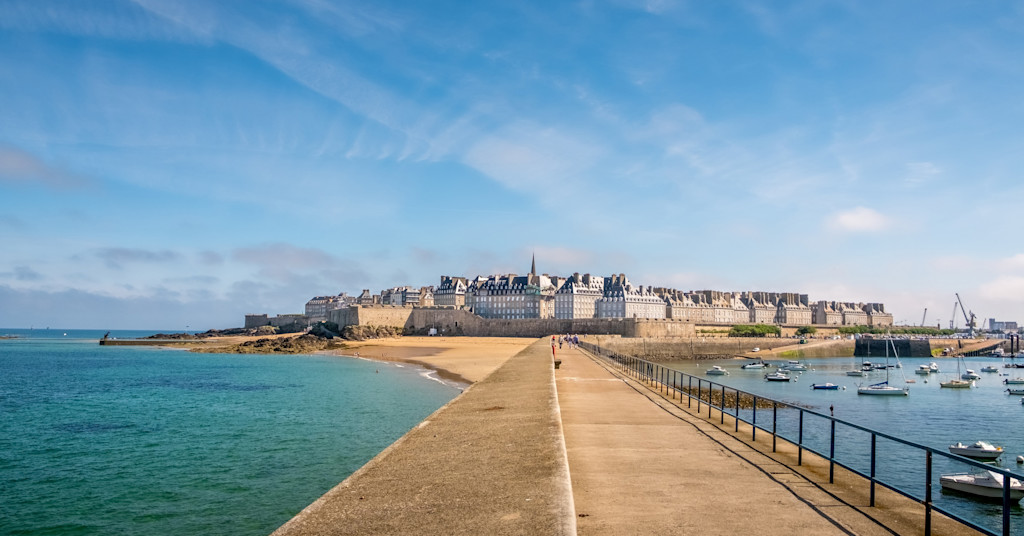
St Malo city viewed from the sea, St Malo City Guide

St Malo: The Corsair City

Year-Round Portsmouth Ferry | 1.8km Ramparts | 13m Tidal Range | Plage de Bon-Secours Tidal Pool | Gateway to the Côte d’Émeraude

⚓ St Malo at a Glance

~2 km
Rampart Walk
Circuit
13 m
Max Tidal
Range
~24 hrs
Portsmouth
Ferry Crossing
1–3 Days
Ideal
Visit Length
  • 1.8km Rampart Walk – Free circuit with views of Fort National, Grand Bé, and Dinard across the estuary
  • Plage de Bon-Secours Tidal Pool – Free seawater pool built 1937, diving board, right beneath the ramparts
  • Fort National – Vauban’s 1689 island fortress, accessible on foot at low tide (June–Oct, €6)
  • Étoile du Roy Corsair Frigate – 47m replica 18th-century privateer ship moored at the quayside (~€6–7)
  • Grand Aquarium – 10,000 fish, 600 species, Nautibus submarine experience (adults €19.90, free parking)
  • Gateway to the Côte d’Émeraude – Dinard 15 min, Dinan 35 min, Mont Saint-Michel 1 hr, Cancale 20 min

Why Visit St Malo?

St Malo rewards visitors in ways that few places can match. It’s a city that has always done things differently — and it shows in every granite wall, every cobbled lane, every extreme tide.

A City That Defies Easy Classification

Walk the ramparts of St Malo and you are standing on some of the most storied ground in France. These granite walls — first built in the 12th century, extended and reinforced by Vauban in the 17th — have withstood English bombardments, Dutch fleets, and American shelling. The old town behind them was 80% destroyed in 1944 and rebuilt stone by stone in its original form — so faithfully that most visitors assume the buildings are genuinely medieval. They read as authentically historic not because they are replicas, but because the reconstruction was done with extraordinary care, using the same granite, the same proportions, the same rooflines. St Malo survived and rebuilt itself on its own terms — Malouin terms.

The corsairs who made St Malo rich in the 17th and 18th centuries were not pirates — they were state-licensed privateers authorised to attack enemy merchant shipping. The distinction mattered enormously in St Malo, where such men as Robert Surcouf became national heroes and built the grand town houses whose rebuilt successors still line the streets today. The wealth of the Malouins funded not just their city but the exploration of the world: it was from St Malo that Jacques Cartier departed in April 1534 to discover Canada.

The Tides: Europe’s Most Dramatic Coastal Theatre

No other element defines St Malo more completely than its tides. The sea here rises and falls up to 13 metres between high and low water — one of the greatest tidal ranges in Europe, and among the highest in the world. The transformation is extraordinary: at high tide, the sea laps the base of the ramparts and Fort National floats as an island; at low tide, vast sandflats emerge around it, a sandy causeway appears to Grand Bé, and Plage de Bon-Secours tidal pool is fully revealed.

The tidal drama shapes everything about how you experience St Malo: which beaches are accessible and when, whether you can walk to Fort National or Grand Bé, the timing of swimming in the tidal pool, and the ever-changing views from the ramparts. Checking the tides before your visit isn’t optional — it’s how you get the most from the city.

The Perfect Base for the Côte d’Émeraude

St Malo’s position on the Côte d’Émeraude — the Emerald Coast — makes it one of the great bases for exploring northern France. Dinard, the Belle-Époque beach resort, is 15 minutes away by car or 10 minutes by the Compagnie Corsaire sea-bus ferry. The perfectly preserved medieval town of Dinan is 35 minutes south. Mont Saint-Michel, the UNESCO World Heritage island abbey, is less than an hour’s drive. And Cancale, France’s oyster capital, is just 20 minutes down the coast.

St Malo’s Extraordinary History

Few cities carry history as visibly as St Malo. Every stone has a story — from the 6th-century Welsh monk who gave the city its name to the Allied shelling that reduced 80% of the old town to rubble in 1944.

From Monk to Republic: The Early Story

In the 6th century, a Welsh monk named Maclovius — Saint Malo — established a monastic community on the rocky islet at the mouth of the Rance. Jacques Cartier, born here in 1491, departed from St Malo on 20 April 1534 on his first voyage of discovery. He sailed up the St Lawrence River, named a hill Mont Royal — later Montréal — and established New France. He is buried in the Cathédrale Saint-Vincent. The Falkland Islands are named Malvinas after Malouins who sailed from this port to settle them in 1764.

From 1590 to 1594, St Malo declared itself the République Malouine — a fully independent city-state. Its motto, “Ni Français, ni Breton — Malouin suis” (Not French, not Breton — I am Malouin), remains the city’s defining statement of character.

The Golden Age of the Corsairs

In the 17th and 18th centuries, St Malo became the home of France’s most celebrated privateers. The corsairs operated under letters of marque issued by the French Crown, licencing them to attack enemy merchant shipping — bringing staggering wealth back to the city. Captains such as Robert Surcouf, who captured over 40 vessels and became a national hero, built grand town houses and funded the elaborate fortifications still visible today.

It was to protect this wealth that Louis XIV commissioned Vauban to build Fort National on the rocky islet just offshore in 1689. The fort you can walk to at low tide today is essentially unchanged. The great military architect also extended and strengthened the town ramparts through his disciple Garangeau; the walls you walk on now are largely his work.

Destroyed and Rebuilt: 1944 and After

In late August 1944, American shelling reduced approximately 80% of Intra-Muros to rubble. The ramparts survived — but the medieval town behind them was almost entirely destroyed. The city was then rebuilt stone by stone in the original style, using the same grey-pink Breton granite, the same proportions, the same roof lines — so faithfully that the difference between an original and reconstructed building is invisible to the untrained eye.

A handful of original structures survived: the ramparts themselves, the Cathédrale Saint-Vincent (badly damaged but structurally intact), and the château towers. The Cathédrale’s extraordinary modern stained glass — installed during the restoration — is itself worth seeing.

St Malo Timeline

6th century — Welsh monk Maclovius (Saint Malo) founds a monastic settlement; the city takes his name.

1491–1534 — Jacques Cartier born in St Malo; departs 20 April 1534 to discover Canada. Buried in the Cathédrale Saint-Vincent.

1590–1594 — St Malo declares itself the République Malouine — a fully independent city-state.

1689 — Vauban builds Fort National on the orders of Louis XIV to defend the port from naval attack.

17th–18th century — Golden age of the corsairs; Robert Surcouf and others bring extraordinary wealth to the city.

1944–1950s — 80% of Intra-Muros destroyed by Allied shelling; rebuilt stone by stone in its original form.

Top Things to Do in St Malo

St Malo rewards exploration at every level — from the panoramic views atop the ramparts to the seawater pool at their foot. Here is everything worth seeing and doing, with verified 2026 admission prices.

Walk the Ramparts

Cost: FREE  |  Distance: 1.8 km circuit  |  Time: 45–60 minutes  |  Access: Multiple gateways and steps around Intra-Muros

The 1.8km circuit of St Malo’s ramparts is one of the great urban walks in France. First built in the 12th century and rebuilt in granite after the great fire of 1661, then extended in the 18th century by Garangeau — a disciple of Vauban — the walls include eight gates, three posterns, three bastions, and multiple towers, all listed historic monuments. The views from the top are extraordinary: Fort National and Grand Bé to the north, Le Sillon beach stretching east, the harbour and Étoile du Roy below, and Dinard’s Belle-Époque villas glittering across the estuary to the west.

💡 Best start point: Porte Saint-Thomas (behind Place Chateaubriand) — Fort National directly ahead, Grand Bé to the left, and the long arc of Le Sillon beach to the right.

Plage de Bon-Secours & Tidal Pool

Cost: FREE  |  Access: Via Porte Saint-Pierre  |  Lifeguards: Seasonal, daily until 7pm

Tucked right at the foot of the ramparts on the western side of Intra-Muros, Bon-Secours is the most iconic beach in St Malo. Its seawater tidal pool — carved into the rock in 1937 by René Lesaunier — retains water even when the tide retreats completely. Three diving boards, a sailing school, kayak hire, and a beach bar with a large terrace make this unmissable. The views of Grand Bé and Petit Bé are among the most photographed in St Malo.

Best time to visit: Low to mid tide for the full pool experience and maximum sand. At high tide the sea washes over the edges, filling the pool fresh — also a spectacular sight.

Fort National

Cost: €6 adults  |  Season: June–October only  |  Access: On foot at low tide when the tricolore flag is raised  |  Duration: ~35 min guided tour

Built in 1689 by Vauban on the orders of Louis XIV, Fort National sits on a rocky islet just off Plage de l’Éventail. When the sea retreats, a sandy causeway appears and the tricolore flag is hoisted to signal that visit hours have begun. Guided tours cover the barracks, cannons, and three centuries of military history — including the fort’s use as a German prison camp in WWII. Check fortnational.com for the day’s opening times, which vary daily with the tides.

⚠️ Tidal warning: The sea returns fast. Never linger on the island as the tide turns. People are rescued every year.

L’Étoile du Roy — Corsair Frigate

Cost: ~€6–7 adults | ~€3 children under 12  |  Location: Quai Duguay-Trouin, beside the tourist office  |  Duration: ~45 minutes  |  Note: Closes 13:00–14:00 daily

Moored right beneath the ramparts, the Étoile du Roy is a full-size 47-metre replica of a 1745 Malouine corsair frigate. Walk her decks, explore the officers’ quarters, cabins, hammocks, navigation instruments, and cannons, while guides explain the crucial difference between a pirate and a privateer — a distinction St Malo takes very seriously indeed. Originally built as the Grand Turk for the ITV series Hornblower. An outstanding family experience.

Grand Bé & Petit Bé Islands

Grand Bé: FREE  |  Petit Bé fort: Small entry charge  |  Access: On foot at low tide only, via Porte des Bés

Grand Bé is the burial place of François-René de Chateaubriand, one of the founders of French Romanticism — his grave is deliberately simple, facing the sea, as he requested. Petit Bé has a fortified castle built by Vauban in the 17th century. Both islands are accessible on foot from Plage de Bon-Secours at low tide only.

⚠️ Critical: Both islands are completely cut off at high tide. Always check tide times before crossing and return to the mainland well before the tide turns.

Cathédrale Saint-Vincent

Cost: FREE. Built between the 12th and 18th centuries, containing Jacques Cartier’s tomb and remarkable post-war stained glass by Jean Le Moal. Adjacent Maison du Québec tells the story of St Malo’s role in founding Canada. Address: Place Jean de Chatillon, Intra-Muros.

Grand Aquarium de Saint-Malo

Adults €19.90 | Children 4–12 €14.90 | Under 4 FREE. 10,000 fish, 600 species, 360° shark tank, Nautibus submarine experience (2025 revamp), Abyssal Descender life simulator. Free parking (500 spaces). Allow 2–2.5 hours. Address: Rue du Général Patton.

Plage du Sillon

Cost: FREE. The long north-facing beach beyond Porte Saint-Thomas. Broad sand with views back to the ramparts and Fort National. Sand yachting (char à voile) at low tide. Backed by the colourful 19th-century villas of Paramé. Access: Boulevard de la Corniche.

Château de Saint-Malo

Château de Saint-Malo — the Dukes of Brittany’s Fortress

Exterior: FREE | Courtyard: check for access | Interior museum: Closed since November 2019 for major renovation — reopening estimated 2028. Address: Place Chateaubriand, at Porte Saint-Vincent, Intra-Muros.

The Château de Saint-Malo is the most visible and historically significant building in Intra-Muros — a severe, powerful fortress that has dominated the entrance to the walled city for six centuries. Construction began in 1424 on the orders of John V, Duke of Brittany, who built the Grand Donjon (Great Keep) on the narrow isthmus then forming the only land crossing between the city and the mainland. His intention was not just to defend St Malo from outside attack — but to keep a firm ducal grip on a city already showing its characteristically independent spirit.

The castle was expanded over the following centuries. Francis II of Brittany added the massive La Générale tower in 1475. His daughter Anne, Duchess of Brittany — who became Queen of France — added the Quic-en-Groigne Tower between 1498 and 1501, its name translating roughly as “whoever grumbles, so be it.” The name was her pointed riposte to the citizens of St Malo, who had objected to her building a fortification inside their walls. The tower’s inscription, “Quic en groigne, ainsi sera, c’est mon plaisir” — Whoever grumbles, this is how it will be, such is my pleasure — remains carved into the stone. Under Louis XIV, Vauban added the barracks buildings along the north and east walls in the late 17th and early 18th centuries; these now house the St Malo town hall.

The castle was heavily damaged in the Allied bombardment of August 1944 and subsequently restored. Its most recent use as a museum — the Musée d’Histoire de la Ville et du Pays Malouin, which occupied the Grand Donjon from the late 1940s — closed in November 2019 for a comprehensive renovation. Reopening is estimated for 2028, though no confirmed date has been given. The rooftop platform on the Grand Donjon, which offered panoramic views across the old city, is part of the same project.

What you can see now (2026): The château exterior is freely viewable from Place Chateaubriand and from the rampart walk — its towers, walls, and the Quic-en-Groigne inscription are fully visible. The building also functions as the current St Malo town hall. While the museum is closed, the exterior architecture alone is one of the most impressive in Brittany and worth seeing as you enter Intra-Muros through Porte Saint-Vincent.

St Malo’s Museums

St Malo’s museums tell genuinely dramatic stories — Atlantic exploration, corsair warfare, and the extraordinary WWII destruction and reconstruction of the city.

Mémorial 39/45 — Cité d’Aleth

Built inside the real WWII German bunkers of Fort de la Cité d’Aleth on the headland south of Intra-Muros. Completely intact tunnels, bunkers, and observation posts with panoramic views over the Rance estuary. The adjacent Tour Solidor (14th-century) is also worth exploring. Address: Fort de la Cité d’Aleth, Saint-Servan.

Musée Jacques Cartier

Adults €6.80 | Children 8+ & students €3.40 | Under 8 FREE | Family (2 adults + 2–4 children) €18.00. The former home of Jacques Cartier himself in Rothéneuf. Summer hours: Mon–Sat 10:00–12:00 & 14:30–18:00. Address: Rue David Macdonald Stewart, Rothéneuf.

Maison du Québec

Located on the rampart walk itself, the Maison du Québec tells the story of St Malo’s role in founding Canada and the remarkable connection between the Malouins and the Falkland Islands. Compact and richly informative — worth the brief stop as you complete the rampart circuit.

Musée des Terre-Neuvas et de la Pêche

Tells the story of the Terre-Neuvas — the St Malo fishermen who made the perilous Atlantic crossing to the Newfoundland cod grounds for generations, one of the city’s less-known but most important maritime chapters. Address: 67 avenue de Moka, Saint-Servan.

Where to Eat in St Malo

St Malo is a genuinely excellent place to eat. Brittany’s seafood-rich cuisine, salted butter tradition, and galette culture are all at their best here — and the concentration of good crêperies and seafood restaurants within Intra-Muros means you’re rarely more than two minutes from something worth eating. Here is what to try, where to go, and what to expect.

What to Eat: The Breton Essentials

Galette de sarrasin — the Breton buckwheat crêpe — is the single most important thing to order in St Malo. Made with buckwheat flour and typically filled with the classic complet (ham, egg, and emmental), or with more ambitious seafood variations, they are served throughout the day in the crêperies of Intra-Muros. Wash them down with Breton dry apple cider — cidre brut — served in a wide ceramic bowl rather than a glass, as is the local tradition.

Moules marinières (mussels steamed in white wine and shallots) and plateaux de fruits de mer (seafood platters of oysters, langoustines, crab, and whelks) are the seafood standards you will see at every brasserie table. From Cancale, just 20 minutes east, come some of the finest oysters in France — order them wherever you see huîtres de Cancale on the menu.

Sweet crêpes with salted caramel are the classic pudding. Brittany’s famous caramel beurre salé — the region has been salt-tax-exempt since the Middle Ages, and used it liberally — is at its best here. Look also for kouign-amann, the caramelised Breton butter cake, in boulangeries throughout the old town. Lunch formules at most restaurants offer outstanding value: two courses for €15–22, often including a kir or glass of wine.

La Maison du Beurre Bordier — A St Malo Institution

The one food stop in St Malo that is genuinely unmissable. In 1985, Jean-Yves Bordier took over the old La Maison du Beurre creamery at 9 rue de l’Orme in Intra-Muros — a shop trading from the same address since 1927 — and transformed it into France’s most celebrated artisan butter operation. He revived the 19th-century method of kneading and hand-shaping butter with wooden paddles, a technique abandoned by virtually every other producer. The result is a butter of extraordinary complexity — salted, textured, and alive in a way that supermarket butter simply isn’t.

The shop sells Bordier butter in around a dozen flavours — plain demi-sel, seaweed (algues), smoked salt, buckwheat, Espelette pepper, lemon and olive oil, and seasonal variants — alongside 230 matured cheeses, charcuterie, dairy desserts, and wine. You can watch the butter being worked through the shop window. It is the sort of place that makes you want to buy more than you can carry. Address: 9 rue de l’Orme, Intra-Muros. The shop is generally closed Sunday afternoons and Mondays — check ahead if visiting off-season.

Next door at 7 rue de l’Orme, the Bistro Autour du Beurre is Bordier’s restaurant — an intimate, wood-and-stone dining room where chef Steve Delamaire builds seasonal menus around local fish and market produce, showcasing the full range of Bordier butters. Expect a butter tasting platter of eight varieties to arrive alongside your bread. Three courses for approximately €35–45. Open for lunch Tuesday–Saturday, dinner Thursday–Saturday. Closed January. Booking strongly recommended. Tel: +33 (0)2 23 18 25 81.

🥞 Crêperie Le Tournesol

Consistently rated one of the best crêperies in St Malo, with a loyal following among locals and returning visitors alike. The Menu Breton — a generous set menu of galettes and sweet crêpes with local cider — is outstanding value. Cosy interior, friendly service. Intra-Muros. Book ahead in summer.

🥞 Crêperie Margaux

Located in a small flower-filled square in the upper part of Intra-Muros. The galettes and sweet crêpes here are excellent, with generous portions and outdoor seating when the weather allows. Popular with families and locals — arrive early or expect a wait in peak season.

🌊 L’Amiral

Upscale waterfront restaurant at the harbour with panoramic views over the port — watch Brittany Ferries sailings while you eat. Strong on seafood and regional Breton produce. Smart dining room. For a special meal with a view, this is the choice. Book ahead.

🍽️ Bouche en Folie

A small, intimate bistro with a menu that changes every few weeks around the best seasonal fish and local produce. Two courses for €22, three for €28 — outstanding value for food of this quality. Very popular; book ahead. Intra-Muros.

Practical Eating Tips

Book ahead in July and August — the best crêperies and restaurants in Intra-Muros fill quickly. Many places are closed Sundays and Mondays off-season.

Explore the side lanes — the main tourist thoroughfares around Place Chateaubriand and the Porte Saint-Vincent are the most convenient but not always the best value. The quieter streets one block back tend to have better food and lower prices.

Lunch is the best-value meal — almost every sit-down restaurant offers a formule at lunchtime: two or three courses for €15–22, often with wine or cider included. The same meal in the evening typically costs 30–40% more.

For a quick meal — the crêperies of Intra-Muros serve all day and are perfectly acceptable for a solo lunch or a light bite between sightseeing. TY Corner on Place du Pilori (galettes, crêpes, fresh juices) is a reliable, busy option used by locals and tourists alike.

Sample Itineraries for St Malo

Whether you have a single full day or are using St Malo as a base for the Côte d’Émeraude, here are optimised itineraries to make the most of your visit.

One Day On Foot — Classic St Malo

08:45 — Breakfast in Intra-Muros

Coffee and a croissant at one of the old town’s bakeries or crêperies. The granite streets are quiet and golden in early morning light.

09:30 — Walk the Ramparts

Start at Porte Saint-Thomas for the best opening view: Fort National directly ahead, Grand Bé to the left, Le Sillon beach to the right. The full 1.8km circuit takes about 1 hour at a relaxed pace.

10:30 — Intra-Muros & Cathedral

Explore the cobbled lanes. Visit the Cathédrale Saint-Vincent and Jacques Cartier’s tomb. Browse rue de Dinan for Bordier butter, salted caramels, and Breton biscuits.

12:00 — Lunch

Moules marinières, a buckwheat galette, or a plateau de fruits de mer at one of the brasseries or crêperies. Book ahead in July and August.

13:30 — Plage de Bon-Secours

Down to the tidal pool. Swim, watch the tide, take in the view. If the tide is right, walk out to Grand Bé for Chateaubriand’s grave — check tide tables before crossing.

15:00 — Étoile du Roy & Quayside

Visit the corsair frigate at the quayside (~45 minutes, ~€6–7). Then walk south to the Château de Saint-Malo exterior and on to the Cité d’Aleth for panoramic views.

19:00 — Dinner

Return to Intra-Muros for dinner. The restaurants around Place Chateaubriand and along the quayside offer everything from smart seafood to relaxed galette suppers.

One Day: Grand Aquarium & Fort National Focus

  • 09:00 — Grand Aquarium (2 hrs, book online in advance) — Rue du Général Patton, free parking on site
  • 11:30 — Ramparts walk (1 hr, FREE) — start at Porte Saint-Thomas
  • 12:30 — Lunch in Intra-Muros crêperie or brasserie
  • 14:00 — Fort National (check tide times at fortnational.com — low tide only, June–October, €6)
  • 15:30 — Étoile du Roy (~45 min, ~€6–7)
  • 17:00 — Plage de Bon-Secours for an evening swim in the tidal pool

Two Days: St Malo + Côte d’Émeraude

  • Day 1: Full on-foot St Malo tour as above
  • Day 2 morning: Drive to Cancale (20 min) — buy a dozen oysters at the port and eat them looking out to sea for under €10
  • Day 2 midday: Drive to Dinard (15 min) — Plage de l’Écluse, iconic striped beach tents, Sentier des Douaniers coastal walk
  • Day 2 afternoon: Continue to Dinan (20 min from Dinard) — medieval old town, Rue du Jerzual, ramparts. Return to St Malo for the evening.

Things to Do Near St Malo

St Malo’s position on the Côte d’Émeraude makes it one of the finest bases for exploring northern France. Within an hour’s drive you can reach a UNESCO World Heritage island abbey, Brittany’s best medieval town, a Belle-Époque beach resort, France’s oyster capital, and some of the most dramatic cliff scenery in Europe.

⛩️ Mont Saint-Michel

The iconic island abbey. UNESCO World Heritage Site and France’s second most visited monument. ~55 km — 1 hour drive. Full guide →

🏰 Dinan

Brittany’s best medieval town. 2.7km of ramparts, 130 half-timbered houses, Rue du Jerzual. ~32 km, 35 min drive. Free parking. Full guide →

🏖️ Dinard

Belle-Époque beach resort. Iconic striped tents, Hitchcock statue, 4km coastal path. ~13 km, 15 min drive or 10 min Corsaire ferry. Full guide →

🦪 Cancale

France’s oyster capital. 5,000 tonnes of oysters farmed across 7km² of bay. Eat a dozen at the quayside for under €10. ~15 km, 20 min drive. Full guide →

🏔️ Cap Fréhel & Fort La Latte

70m pink sandstone cliffs, nesting seabird colonies, and a 14th-century clifftop fortress. Fort La Latte: €7.80 adults (open Mar–Nov). ~50 km, 50 min drive.

🥾 The GR34 Coastal Path

The famous Sentier des Douaniers runs 2,000km around the entire Breton coast. The Cancale to St Malo section and the Cap Fréhel to Fort La Latte stretch are the finest near the city. Full guide →

Cancale: More Than Just Oysters

Cancale is best known for its oyster market at the harbour — eight producers sell directly to visitors every day, and eating a freshly shucked dozen on the quayside steps with Mont Saint-Michel visible in the distance is one of the great simple pleasures of Brittany. But there is more to Cancale than oysters. The Ferme Marine runs guided tours of a working oyster farm with tastings included. The Pointe du Grouin headland, 7km to the north, is one of the most dramatic viewpoints on the entire Côte d’Émeraude — jagged cliffs above a bird reserve with views stretching across the bay to Mont Saint-Michel. The GR34 coastal path from Cancale back towards St Malo (the Sentier des Douaniers) is among the finest short coastal walks in Brittany.

Getting there: ~20 minutes east by car (D355 coastal road). Bus Ligne 5 from St Malo bus station also serves Cancale — ask at the tourist office for current timetables.

Cap Fréhel & Fort La Latte: The Finest Coastal Drive from St Malo

About 50 minutes west along the Emerald Coast, Cap Fréhel is one of the most spectacular headlands in Brittany. Its pink sandstone cliffs drop 70 metres sheer to the sea, the moorland behind them covers 400 hectares of gorse and heather, and the bird reserve on the offshore islets hosts colonies of guillemots, razorbills, kittiwakes, and fulmars. The 103-metre lighthouse — built in 1950 — is open for climbing in summer (small fee). Parking at Cap Fréhel costs €3 per car.

A few kilometres east along the GR34, Fort La Latte is the most dramatically sited castle in Brittany — a 14th-century clifftop fortress perched on a rocky headland above the sea. Its drawbridge, curtain walls, towers, and keep are all intact and open to visitors. The walk between Cap Fréhel and Fort La Latte along the clifftop GR34 path takes around 1 hour 15 minutes each way and is outstanding.

Fort La Latte admission: €7.80 adults | €6.50 students | €5.50 children | Open daily March–November (10:30 from April, check fortlalatte.com for seasonal hours). Getting there: ~50 km west by car via D786.

Ready to plan your Côte d’Émeraude adventures? Our dedicated day trips hub has complete guides to every destination — with detailed directions, parking, opening times, and insider tips for each.

Explore All Day Trips from St Malo →

Practical Information for Your Visit

Everything you need to know before you arrive in St Malo — parking, tides, food, and getting your bearings.

Parking in St Malo

There is no free parking close to Intra-Muros during the day. The best approach is to use one of the main car parks outside the walls and walk in. Main options: Parking Esplanade Saint-Vincent (closest to Porte Saint-Vincent, paid), Parking Galère (by the north beach, paid), and larger car parks around the port and ferry terminal. Parking is generally free on Sundays and public holidays in most zones.

In July and August, arrive early — car parks fill by mid-morning. The ferry terminal long-stay car park is well managed for overnight stays. For the Grand Aquarium, free parking with 500 spaces is available on site at Rue du Général Patton.

⚠️ Tidal Safety — Read Before You Visit

The tides at St Malo are among the highest in Europe — up to 13 metres between high and low water. When visiting Fort National, Grand Bé, or Petit Bé on foot, always check the tide times in advance. Return to the mainland well before the tide turns — the sea comes back faster than most visitors expect and people are rescued every year.

For Fort National specifically, visit times vary daily according to the tides. Check fortnational.com before visiting. The tricolore flag above the fort signals when access is open. Never attempt to cross to any tidal island once the tide has begun to return.

Food & Drink — Quick Reference

See the full Where to Eat section above for recommended restaurants, crêperies, and the Bordier butter shop. For quick reference: most crêperies and brasseries in Intra-Muros serve from midday through to late evening. Reservations are strongly recommended in July and August at any sit-down restaurant. Crêperies generally do not require booking for lunch on weekdays outside peak season.

The tourist office at Porte Saint-Vincent can provide updated restaurant recommendations and current opening days if you are visiting off-season. Most of Intra-Muros is very walkable — if a crêperie you were planning to visit is full, there will almost certainly be another excellent option within 100 metres.

Best Time to Visit

July–August: Warmest and liveliest — beaches full, all attractions operating. Most crowded and most expensive; book restaurants ahead. Parking fills by mid-morning.

May, June, September: Excellent balance of good weather, manageable crowds, and everything open. Highly recommended for first-time visitors.

October–April: Quieter and more authentically local. Old town and beaches are spectacular in autumn and winter — dramatic skies, massive tides, no queues. Fort National and some seasonal attractions are closed, but the city is fully open year-round.

St Malo Visitor Guide: Frequently Asked Questions

Everything visitors arriving by ferry from Portsmouth most commonly ask about St Malo — answered with verified 2026 information.

Is St Malo worth visiting?

Yes — absolutely. St Malo is one of the most rewarding destinations in France for British visitors arriving by ferry. The walled old town of Intra-Muros is exceptional: 1.8km of 17th-century granite ramparts you can walk for free, cobbled streets lined with corsair history, and the famous Plage de Bon-Secours tidal pool right beneath the walls. Add the most dramatic tides in Europe — up to 13 metres — which transform the entire landscape twice daily, Fort National accessible on foot at low tide, and a corsair frigate moored at the quayside, and St Malo delivers experiences found nowhere else. As a base for the Côte d’Émeraude it is outstanding: Dinard, Dinan, Cancale, and Mont Saint-Michel are all within an hour.

How many days do you need in St Malo?

One full day is enough to see St Malo’s highlights on foot: the rampart walk, Intra-Muros old town, Plage de Bon-Secours, Fort National (tide permitting), and the Étoile du Roy corsair frigate. Two days allows you to add the Grand Aquarium and explore one or two nearby destinations — Cancale for oysters, Dinard across the estuary, or Dinan’s medieval old town. Three days or more works well if you want to combine St Malo with Mont Saint-Michel and explore further along the Emerald Coast. Most Portsmouth ferry passengers find two nights gives a satisfying and unhurried visit.

What is the best time of year to visit St Malo?

May, June, and September offer the best balance: reliably good weather, all attractions open, and significantly fewer crowds than July and August. July and August are the warmest months and the most lively — beaches are at their best and Fort National is fully open — but car parks fill early, restaurants need booking, and the old town is very busy. October through April is quieter and more authentically local, with dramatic winter tides that are spectacular from the ramparts; note that Fort National closes after October. St Malo is worth visiting year-round — its walled old town and beaches are accessible in any season.

Can you walk to Fort National at any time?

No — Fort National is only accessible on foot at low tide, and only when the tricolore flag is raised above it to signal that visiting hours are open. It is open June through October only; outside these months it is closed to visitors. Because St Malo’s tidal range reaches up to 13 metres, the access times change every single day. Always check fortnational.com before visiting to find the day’s specific opening window. The sea returns faster than most people expect — never linger on the island once the tide begins to turn. Admission is €6 per adult (2026).

Is the rampart walk in St Malo free?

Yes — the full 1.8km rampart walk around Intra-Muros is completely free and open every day. You can access the walls via steps at the main gates: Porte Saint-Vincent, Porte Saint-Thomas, and Porte des Champs Vauverts are the most commonly used entry points. The circuit takes around 45–60 minutes at a relaxed pace and gives panoramic views of Fort National, Grand Bé, the harbour, the Étoile du Roy, and Dinard across the Rance estuary. It is the single most unmissable thing to do in St Malo and requires no planning, no booking, and no cost.

Can you swim at Plage de Bon-Secours?

Yes — Plage de Bon-Secours has one of the finest swimming spots in St Malo. Its seawater tidal pool, built in 1937 by René Lesaunier, retains water at all states of the tide, making it usable even when the sea has retreated across the sand flats. The pool has three diving boards and is guarded by lifeguards during the season. The beach itself offers open-water swimming at mid to high tide. Entry to both the beach and tidal pool is free. The best swimming is at mid tide — the pool is full, the sea accessible, and the sand revealed. At high tide in summer, waves wash over the pool edges, which is equally spectacular but not ideal for lap swimming.

How far is Mont Saint-Michel from St Malo?

Mont Saint-Michel is approximately 55km from St Malo and takes around 55–60 minutes by car via the D155 and A84. It is one of the most popular day trips from St Malo and is very manageable as a full day out. Aim to arrive early — before 9am in summer — to avoid the worst of the crowds and to see the island at its most atmospheric before coach parties arrive. The island abbey is open daily and entry must be booked in advance in July and August. You can also reach Mont Saint-Michel by Keolis Emeraude coach from St Malo bus station. See our full Mont Saint-Michel day trip guide for detailed directions, parking, and insider tips.

Where should I park in St Malo?

There is no free daytime parking close to Intra-Muros. The most convenient paid options are Parking Esplanade Saint-Vincent (immediately outside Porte Saint-Vincent) and Parking Galère (near the north beach). Larger car parks around the port and ferry terminal are also well-placed. Parking is generally free on Sundays and public holidays in most zones. In July and August, arrive before 9am — car parks fill quickly and the approach roads become congested by mid-morning. If you are visiting the Grand Aquarium, free parking with 500 spaces is available on site at Rue du Général Patton.

What language did the people of St Malo speak?

Today St Malo is a French-speaking city, though a strong Breton cultural identity persists. Historically, the Malouins spoke a dialect that blended French, Breton, and Norman influences, reflecting the city’s extraordinary position as a crossroads of maritime trade. The city’s famous motto — “Ni Français, ni Breton — Malouin suis” (Not French, not Breton — I am Malouin) — captures the fiercely independent spirit that led St Malo to declare itself a fully independent republic from 1590 to 1594. In practice today, English is widely understood in the old town and tourist areas, particularly in hotels, restaurants, and at major attractions.
Plan Your Portsmouth Ferry Journey

St Malo Ferry

Complete guide to the Portsmouth to St Malo ferry – ships, timetables, facilities, cabins, and booking tips

Portsmouth – St Malo Guide →

🛏️

Ferry Cabins

Admiral suites, Commodore, pet-friendly, and family cabins on MV Saint-Malo and Armorique

Cabins Guide →

🍽️

Onboard Facilities

Restaurants, bars, Wi-Fi, entertainment, shopping, and kids’ activities on Portsmouth St Malo ferries

Facilities Guide →

Ferry Timetable

2026 sailing schedule, departure times, seasonal variations, and frequency for Portsmouth St Malo route

Timetables →

Ready to Discover St Malo?

St Malo is one of those rare places that delivers more than it promises. The granite ramparts are even more dramatic in person, the tides even more extraordinary, the cobbled streets of Intra-Muros even more full of life. The corsair history isn’t just a story on a plaque — it is the reason the city exists in the form it does today, and you can feel it in every granite building, every seafood restaurant, every mention of the Malouins’ defiant motto.

With this complete St Malo guide, you have everything you need: the rampart walk, Plage de Bon-Secours tidal pool, Fort National at low tide, the Étoile du Roy corsair frigate, the story of Jacques Cartier and the privateers, practical parking and tide advice, and the best things to do near St Malo — all verified for 2026. The Corsair City is waiting.

🚢

Book Your Ferry

Year-round Portsmouth to St Malo sailings — the classic way to arrive in Brittany

🧱

Walk the Ramparts

1.8km of 12th-century granite walls — Fort National, Grand Bé, and Dinard all visible from the top

🏖️

Hit the Beach

Plage de Bon-Secours tidal pool and diving board right beneath the ramparts — free entry

🗺️

Explore the Region

Dinard, Dinan, Mont Saint-Michel, Cancale, Cap Fréhel — all within an hour of St Malo

St Malo Awaits — Sail Direct from Portsmouth

Brittany Ferries sails year-round from Portsmouth to St Malo. Step off the ferry and straight into one of the most extraordinary walled cities in Europe — corsair history, world-class beaches, 13-metre tides, and the best things to do in northern France all within easy reach.

Book Brittany Ferries Now →

Safe travels, and may St Malo’s Corsair Coast exceed every expectation.