Everything visitors arriving by ferry from Portsmouth most commonly ask about St Malo — answered with verified 2026 information.
Is St Malo worth visiting?
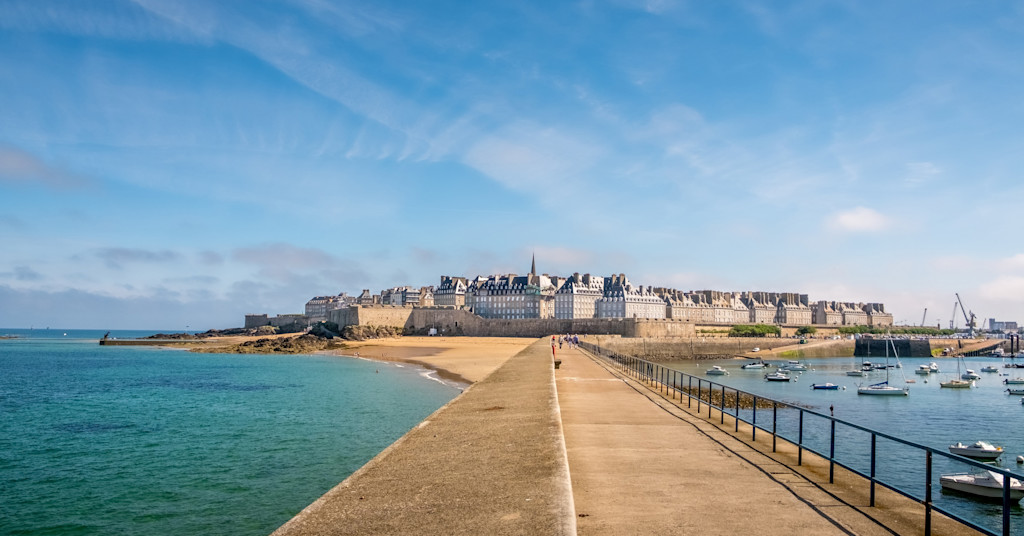
Yes — absolutely. St Malo is one of the most rewarding destinations in France for British visitors arriving by ferry. The walled old town of Intra-Muros is exceptional: 1.8km of 17th-century granite ramparts you can walk for free, cobbled streets lined with corsair history, and the famous Plage de Bon-Secours tidal pool right beneath the walls. Add the most dramatic tides in Europe — up to 13 metres — which transform the entire landscape twice daily, Fort National accessible on foot at low tide, and a corsair frigate moored at the quayside, and St Malo delivers experiences found nowhere else. As a base for the Côte d’Émeraude it is outstanding: Dinard, Dinan, Cancale, and Mont Saint-Michel are all within an hour.
How many days do you need in St Malo?
One full day is enough to see St Malo’s highlights on foot: the rampart walk, Intra-Muros old town, Plage de Bon-Secours, Fort National (tide permitting), and the Étoile du Roy corsair frigate. Two days allows you to add the Grand Aquarium and explore one or two nearby destinations — Cancale for oysters, Dinard across the estuary, or Dinan’s medieval old town. Three days or more works well if you want to combine St Malo with Mont Saint-Michel and explore further along the Emerald Coast. Most Portsmouth ferry passengers find two nights gives a satisfying and unhurried visit.
What is the best time of year to visit St Malo?
May, June, and September offer the best balance: reliably good weather, all attractions open, and significantly fewer crowds than July and August. July and August are the warmest months and the most lively — beaches are at their best and Fort National is fully open — but car parks fill early, restaurants need booking, and the old town is very busy. October through April is quieter and more authentically local, with dramatic winter tides that are spectacular from the ramparts; note that Fort National closes after October. St Malo is worth visiting year-round — its walled old town and beaches are accessible in any season.
Can you walk to Fort National at any time?
No — Fort National is only accessible on foot at low tide, and only when the tricolore flag is raised above it to signal that visiting hours are open. It is open June through October only; outside these months it is closed to visitors. Because St Malo’s tidal range reaches up to 13 metres, the access times change every single day. Always check fortnational.com before visiting to find the day’s specific opening window. The sea returns faster than most people expect — never linger on the island once the tide begins to turn. Admission is €6 per adult (2026).
Is the rampart walk in St Malo free?
Yes — the full 1.8km rampart walk around Intra-Muros is completely free and open every day. You can access the walls via steps at the main gates: Porte Saint-Vincent, Porte Saint-Thomas, and Porte des Champs Vauverts are the most commonly used entry points. The circuit takes around 45–60 minutes at a relaxed pace and gives panoramic views of Fort National, Grand Bé, the harbour, the Étoile du Roy, and Dinard across the Rance estuary. It is the single most unmissable thing to do in St Malo and requires no planning, no booking, and no cost.
Can you swim at Plage de Bon-Secours?
Yes — Plage de Bon-Secours has one of the finest swimming spots in St Malo. Its seawater tidal pool, built in 1937 by René Lesaunier, retains water at all states of the tide, making it usable even when the sea has retreated across the sand flats. The pool has three diving boards and is guarded by lifeguards during the season. The beach itself offers open-water swimming at mid to high tide. Entry to both the beach and tidal pool is free. The best swimming is at mid tide — the pool is full, the sea accessible, and the sand revealed. At high tide in summer, waves wash over the pool edges, which is equally spectacular but not ideal for lap swimming.
How far is Mont Saint-Michel from St Malo?
Mont Saint-Michel is approximately 55km from St Malo and takes around 55–60 minutes by car via the D155 and A84. It is one of the most popular day trips from St Malo and is very manageable as a full day out. Aim to arrive early — before 9am in summer — to avoid the worst of the crowds and to see the island at its most atmospheric before coach parties arrive. The island abbey is open daily and entry must be booked in advance in July and August. You can also reach Mont Saint-Michel by Keolis Emeraude coach from St Malo bus station. See our full Mont Saint-Michel day trip guide for detailed directions, parking, and insider tips.
Where should I park in St Malo?
There is no free daytime parking close to Intra-Muros. The most convenient paid options are Parking Esplanade Saint-Vincent (immediately outside Porte Saint-Vincent) and Parking Galère (near the north beach). Larger car parks around the port and ferry terminal are also well-placed. Parking is generally free on Sundays and public holidays in most zones. In July and August, arrive before 9am — car parks fill quickly and the approach roads become congested by mid-morning. If you are visiting the Grand Aquarium, free parking with 500 spaces is available on site at Rue du Général Patton.
What language did the people of St Malo speak?
Today St Malo is a French-speaking city, though a strong Breton cultural identity persists. Historically, the Malouins spoke a dialect that blended French, Breton, and Norman influences, reflecting the city’s extraordinary position as a crossroads of maritime trade. The city’s famous motto — “Ni Français, ni Breton — Malouin suis” (Not French, not Breton — I am Malouin) — captures the fiercely independent spirit that led St Malo to declare itself a fully independent republic from 1590 to 1594. In practice today, English is widely understood in the old town and tourist areas, particularly in hotels, restaurants, and at major attractions.