Affiliate Disclosure: This site contains affiliate links. If you book through these links we may earn a small commission, at no extra cost to you.
Taking a Motorbike on the Portsmouth to St Malo Ferry: The Complete 2027 Guide
The Portsmouth to St Malo route is one of the finest ferry crossings in Europe for motorcyclists. An overnight sailing of around 11 hours 30 minutes on the MV Saint-Malo drops you in Brittany refreshed and ready to ride — with some of France’s best touring roads just minutes from the port. Whether you’re heading to Normandy, the Loire Valley, the Alps or beyond, getting your bike on board is simpler than you might think. This guide for taking your motorbike on the Portsmouth to St Malo ferry covers everything: booking, prices, check-in, how your bike is secured on the car deck, what to pack, and what you need to ride legally in France.
Last updated: October 2026 | Prices and information verified from official Brittany Ferries sources
🏍️ Motorbike Ferry Fast Facts — Portsmouth to St Malo
£92+
From (solo rider + bike)
45 min
Check-in closes before departure
~11.5 hrs
Crossing time Portsmouth–St Malo
2 max
Passengers per bike booking
✅ Motorbikes accepted on all sailings — book online as a vehicle, specifying motorcycle type
✅ Up to 2 passengers per bike booking — solo rider or rider + pillion both covered
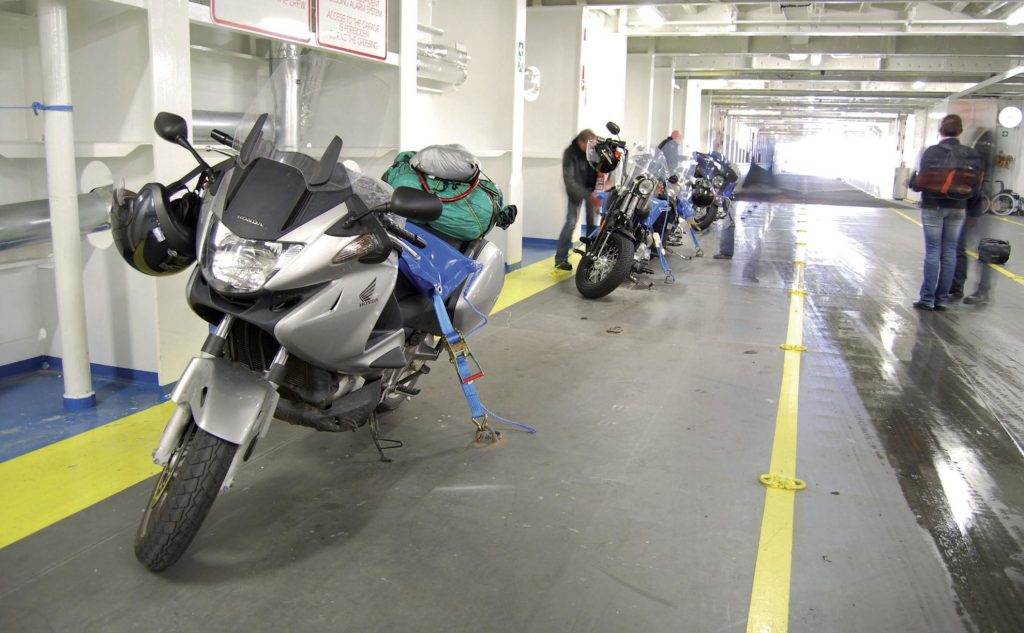
✅ Crew will secure your bike with ratchet straps and foam pads — no tools needed from you
✅ Cabin required for the overnight sailing — the Portsmouth departure (20:15) arrives in St Malo at 08:45 French time
✅ No pets with motorcyclists — a separate vehicle booking is needed for pets; recognised assistance dogs are the exception
For motorcyclists in the south of England, the Portsmouth to St Malo route consistently ranks as the most civilised way to get to France. The MV Saint-Malo is a full-sized cruise ferry — 194.7 metres long, with ten decks (five of them for passengers), restaurants, a bar, lounges and comfortable cabin accommodation. You’re not cramming into a short hop to Calais; you’re doing an overnight crossing that functions as the first night of your trip.
Depart Portsmouth at 20:15, spend the evening in the bar or restaurant, sleep in your cabin, and wake up to breakfast on board before riding off the ramp in St Malo at 08:45 local time. You’ve already covered the boring motorway miles before the riding even begins. From the port, the N137 dual carriageway puts you straight onto the French road network — Normandy, Brittany, the Loire, Bordeaux, the Pyrenees, and ultimately Spain are all within a day’s ride.
The route is also competitive on price. Solo riders travelling with their bike can book from £92+ one way, with the cabin added separately. For a two-up touring trip, two passengers plus a motorbike starts from £134+.
Motorbike Ferry Prices 2027 — Portsmouth to St Malo
Brittany Ferries prices motorbike tickets per vehicle booking, covering the bike and up to two passengers (rider and pillion). Fares vary by date and how far in advance you book — the prices below are verified 2027 one-way starting fares from Brittany Ferries directly. A cabin must be added for the overnight Portsmouth departure on MV Saint-Malo (on the Armorique, which operates a small number of sailings from 7 to 20 March 2027, you can choose a cabin or a reserved seat). On the daytime return a cabin is optional but popular.
💡 Booking tip: Motorbike ferry spaces — especially in summer peak season — sell out faster than car spaces. The bike deck has limited capacity and motorcyclists tend to book early for touring holidays. Book 6–12 months ahead for July and August sailings. The cheapest fares are usually Brittany Ferries’ Early Bird tickets, available when you book 60 or more days ahead — you pay in full at booking, changes cost £20, and they’re non-refundable. See our prices and booking guide for every ticket type.
⚠️ No pets on motorbike bookings: Brittany Ferries does not permit pets to travel with motorcyclists. If you want to bring a dog or cat, you will need a separate vehicle booking with a pet-friendly cabin or kennel. Recognised assistance dogs are the exception — including dogs accredited by ADI, ADUK, ADEU, ADEI, IGDF or ADAA, and medical alert dogs trained by recognised charities. They travel free, can stay in any cabin and go anywhere in the public areas, but must wear a jacket, harness or lead showing they’re a working dog and meet the usual travel rules for dogs. Owner-trained assistance dogs may be accepted after assessment — email Pettravelexpert@brittanyferries.com. Emotional support animals count as regular pets. If you’re bringing an assistance dog without an enclosed vehicle (such as a car, van, minibus, motorhome or car and caravan) — on a motorbike, for example — you can’t book online: call Brittany Ferries on 0330 159 7000 to make the booking.
Ready to Book Your Motorbike on the Ferry?
Motorbike spaces on peak summer sailings sell out months in advance. Book early to secure your space and get the best fare.
How to Book Your Motorbike on the Portsmouth to St Malo Ferry
Booking a motorbike on the Portsmouth to St Malo ferry is straightforward — it’s handled exactly like a car booking, with a few extra fields to fill in about your bike. You book directly through the Brittany Ferries website or via an approved agent.
1
Select “Motorcycle” as Your Vehicle Type
When starting a booking on the Brittany Ferries website, select Motorcycle as your vehicle type rather than car. You’ll be asked to enter your registration number and the make and model of your bike. Be accurate — the ship’s loading team use this information to plan placement on the car deck. Enter the correct number of passengers (1 for solo, 2 for rider + pillion).
2
Add a Cabin
For the overnight Portsmouth to St Malo sailing (departs 20:15, arrives 08:45 local time), you must add a cabin to your booking — MV Saint-Malo has no reserved seats, so you cannot board an overnight crossing without one. The most popular choice for motorcyclists is the 2-berth inside Club cabin — comfortable twin beds, ensuite bathroom, tea and coffee. The 4-berth inside cabin is the most economical. For a treat, the Commodore cabin includes sea views and lounge access with breakfast. Add your cabin during the booking process before confirming your reservation.
3
Check Your Confirmation Email
Brittany Ferries issue an e-ticket — there are no paper tickets. Save your confirmation email and have the booking reference accessible at check-in. Your confirmation will show your crossing details, cabin allocation, and the check-in time. Check this carefully — check-in for motorbikes closes 45 minutes before departure. That’s a deadline, not an arrival time: aim to arrive at least an hour before it, and many riders on this route arrive 90 minutes to 2 hours before sailing in peak season.
4
Sidecars & Two Bikes on One Booking
If you’re travelling with a sidecar outfit, select the sidecar option during booking — the pricing tier covers 2 passengers with a motorcycle and sidecar combination. If two riders are travelling together each on their own machine, this is also covered under the £180+ tier (2 people, 2 bikes). If more than two of you are riding together, each additional bike needs its own booking.
Check-In at Portsmouth International Port with a Motorbike
Portsmouth International Port is the departure point for the ferry to St Malo. The port sits at the end of the M275, well signposted from the M27 and A27. Motorbike check-in follows the same process as vehicles, with a few things worth knowing in advance. For every check-in deadline, see our check-in guide.
1
Check-In Closes 45 Minutes Before Departure
Brittany Ferries’ check-in for vehicles and motorbikes closes 45 minutes before departure — 19:30 for the 20:15 Portsmouth sailing. This is a deadline, not an arrival time: aim to arrive at least an hour before it, so by around 18:30. If you miss the deadline, the ship will leave without you and you won’t get a refund. Experienced motorcyclists on this route typically arrive 90 minutes to 2 hours before departure to avoid any last-minute pressure and to get a good position in the bike loading queue.
2
Check-in Booth — Documents Ready
Follow the signs to the Brittany Ferries vehicle embarkation check-in booths. Have your booking reference and your passport ready, and be prepared to take your helmet off — you may be asked to remove it for the passport and security checks. You’ll be issued a boarding card which also serves as your cabin key. Keep this safe — you’ll need it to access your cabin and during arrival in St Malo.
3
Security and Holding Lanes
After check-in you’ll go through the port’s passport and security checks (have your helmet ready to come off if asked) and then into the vehicle holding lanes to await boarding. Motorbikes are typically marshalled together in a dedicated motorcycle area. Keep your helmet, gloves and all riding gear on while in the holding lanes and on the loading ramp — the surfaces can be slick and there is vehicle movement around you. Brittany Ferries policy requires helmets to be worn whenever your bike is in motion.
4
Boarding — Take Your Time on the Ramp
When directed to board, ride carefully. Loading ramps can be wet and greasy — brake gently and avoid any sudden steering inputs. Crew will guide you to your parking position on the car deck. Motorcycles are loaded in a specific order based on type and size, so don’t be surprised if cars or other vehicles move ahead of you — this is normal for efficient deck planning. Once positioned, a crew member will secure your bike immediately.
🚨 Bike alarm warning: Switch off your motorcycle alarm — or put it into transport mode — before boarding. Alarms triggered by the movement of the ship during the crossing are one of the most common problems on the car deck, and an alarm sounding in a sealed car deck all night is not popular with Brittany Ferries crew or fellow passengers. If you’re unsure how to disable it, check your owner’s manual before the sailing day.
How Your Bike is Secured on the Car Deck
This is one of the questions most first-time motorcycle ferry passengers ask, and understandably so — your pride and joy is parked in a sealed car deck overnight while the ship crosses open water. Brittany Ferries has a well-established, crew-led process for securing bikes, and it is genuinely good.
🔧 Ratchet Straps & Foam Pads
A trained crew member will secure your bike using heavy-duty ratchet straps fixed to deck shackles, running over the seat of the bike. Thick foam pads are placed between the strap and your seat to prevent any damage or marking. You do not need to provide your own straps — Brittany Ferries supply everything and the crew handle the entire process. If you carry your own ratchet straps and prefer to use them, you can, but the crew will check the result before you leave the deck.
🏍️ Sidestand, First Gear & Chocks
Your bike will be parked on the sidestand (not the centrestand) where possible, as this creates a wider, more stable base. Leave your bike in first gear — this prevents rolling if a strap shifts during the crossing. Where appropriate, chocks are used under the wheels for additional stability. The crew are experienced with all types of machines including adventure bikes, cruisers, sports bikes and large touring outfits.
📝 Before You Leave the Deck
Once your bike is secured, note down your car deck number and the nearest exit door or lift number — you’ll need this to find your bike quickly on arrival. Take everything you need for the crossing with you: overnight bag, helmet if you’re removing it, documents, chargers, medications. You cannot return to the car deck once the ship has sailed. The deck is sealed for the duration of the crossing.
⚠️ Luggage & Soft Panniers
If you have soft panniers, tank bags or a tail pack, remove anything you need overnight before leaving the deck. Soft luggage left on the bike is generally fine — the strapping process will not disturb it — but anything loose or poorly attached could shift during a rough crossing. Hard luggage is more secure; if you have locking panniers, lock them before leaving. Do not leave valuables in luggage on the deck.
💡 Rider tip — protect your seat: Although Brittany Ferries use foam pads, some riders with custom or expensive seats carry a small piece of neoprene or a folded microfibre cloth as extra protection and peace of mind. This takes up virtually no space in a jacket pocket and is a habit worth forming on any ferry crossing. Do not over-tighten if you use your own straps — a strap cranked too tight against a foam seat can crack the seat pan or break a seat hinge, which has happened to other riders on other operators.
Onboard the MV Saint-Malo — What to Expect
Once you’ve left the car deck and found your cabin, the MV Saint-Malo has everything you need for a comfortable overnight crossing. There’s no rush — the ship departs at 20:15 and arrives in St Malo at 08:45 local time (07:45 UK time), giving you around 11 hours 30 minutes onboard. Between 7 and 20 March 2027 the Armorique operates a small number of sailings instead of the Saint-Malo.
🛏️ Cabins
Your cabin is allocated at booking. The boarding card doubles as a key card. Soap and towels are provided in all cabins. If you’re travelling without a cabin — on daytime sailings, or overnight on the Armorique with a reserved seat — public showers are available on board and sleep packs (pillow, blanket) can be purchased at the information desk. You can head straight to your cabin after leaving the car deck.
The MV Saint-Malo has a French brasserie (Le Littoral, Deck 7) with buffet and main dishes, a quicker counter-service option (Le Jardin, Deck 8, serving locally sourced seasonal produce), CClub (Deck 8) — a lounge-restaurant anyone can book, with a dinner buffet at £47 and breakfast at £16 — and the Breizh Ma Bro bar. Meals aren’t included in standard fares. Le Littoral doesn’t take bookings, so go early for dinner in peak season. Note that all departure times are quoted in local port time, but onboard clocks run on UK time throughout the crossing.
The information desk and ship’s reception is located on Deck 7, open 24 hours and staffed by bilingual crew. They handle any issues during the crossing, including wake-up calls (requested the night before — strongly recommended). You’ll receive an automatic wake-up call approximately 60 minutes before arrival in St Malo. Allow enough time for breakfast, to collect your belongings and be ready to return to the car deck when called.
🎒 Rider Bag — What to Bring Upstairs
Pack a small overnight bag before you board — passport, boarding card, phone and charger, a change of clothes or trainers for the evening, any medications, cash or cards. Helmet and heavy riding gear can be left on or with your bike if your panniers lock; otherwise carry them up with you. A pair of trainers or light shoes makes the evening on board much more comfortable after a full day in boots. Remember — no access to the car deck once underway.
🍺 Onboard alcohol & French limits: It’s tempting to enjoy a few drinks at the bar on a relaxed overnight crossing — and there’s nothing wrong with that. But be aware that French blood alcohol limits for motorcyclists are lower than in the UK (0.05% BAC compared to 0.08% in England and Wales — and just 0.02% for riders who have held their licence for less than three years). If you’re riding off the ferry at 08:45 local time after an evening of drinks, you may still be over the French legal limit. Plan accordingly — either drink moderately the evening before, or allow time after arrival before riding.
Arriving in St Malo — Off the Ferry and on the Road
The MV Saint-Malo docks at the Gare Maritime du Naye in St Malo. An announcement will be made when you can return to the car deck — do not start your engine until instructed by crew. Follow the crew’s directions and be patient; motorcycles may be unloaded before or after cars depending on the deck layout and loading order for the return sailing. Brittany Ferries’ paid Priority Disembarkation isn’t available for motorbikes.
1
French Border Control and EES
French passport control is completed in St Malo after disembarking — not at Portsmouth before you leave. If it’s your first trip into the Schengen area since the Entry/Exit System (EES) went fully live on 10 April 2026, you’ll register here with fingerprints and a photo (children under 12 don’t give fingerprints), so allow extra time. Have your passport easily accessible in a jacket pocket or tank bag; you don’t want to be removing gloves and opening panniers at the booth. The process is generally smooth, but delays can occur in summer.
2
First Stop After the Port
Once clear of the port, pull over somewhere safe before you hit the road. Check your bike over — straps removed (hopefully by crew), luggage secure, tyre pressures correct after a night without riding. Adjust mirrors. If your bike has a left-biased headlight beam (most older bikes do), fit a headlight beam deflector before riding — French law requires you not to dazzle oncoming drivers, and it’s simply courteous. Many modern bikes with flat or symmetric beams don’t need one, but check before you go. Get your bearings, get a coffee, and begin the ride refreshed.
3
Time Difference
France is 1 hour ahead of the UK all year round. The ship runs on UK time throughout the crossing, so when the announcement says you’ll arrive at 08:45, that is local French time — it’s 07:45 by your body clock. Factor this into any plans for breakfast in St Malo or an early morning ride. Your phone will update automatically once it connects to a French network.
Documents You Need to Ride a Motorbike in France
Riding in France requires a specific set of documents carried on your person or with the bike at all times. A gendarmerie stop is not uncommon on popular touring routes — having everything in order saves a great deal of hassle.
📋 Full Documents Checklist
Valid passport — required for ferry boarding and French border control
Full motorcycle driving licence (photocard) for the correct category
V5C registration document (original or certified copy) — proof of ownership
Proof of insurance valid for riding in France — check your policy before travelling
Booking confirmation / e-ticket for the ferry crossing
UK identifier sticker or plate incorporating “UK” — a “GB” sticker is no longer valid
Crit’Air sticker if you plan to ride into the low-emission zones that many French cities now have
🪪 Driving Licence — Do I Need an IDP?
No — if you hold a current UK photocard driving licence, you do not need an International Driving Permit (IDP) to ride in France. Your UK photocard licence is recognised in France post-Brexit for short visits.
If you still hold an old-style green or pink paper licence, you will need either an IDP or to update to a photocard licence before travelling. IDPs are available in person from shops displaying a PayPoint sign (the Post Office stopped issuing IDPs from 1 April 2024). The cost is £5.50 and is issued immediately.
🔵 UK Identifier — No More “GB”
Since September 2021, vehicles travelling in the EU must display a “UK” identifier — the old “GB” sticker or oval plate is no longer valid. This applies to all UK-registered vehicles including motorcycles.
If your number plate already shows the UK flag and “UK” within the plate design, you do not need a separate sticker. If your plate shows GB, or has no identifier at all, attach a UK sticker to the rear of the bike or a hard pannier where it is clearly visible. Fines apply for non-compliance in France.
💡 Insurance for Europe
Check your motorcycle insurance policy before you travel. Many UK policies now provide only third-party cover in the EU post-Brexit, even if you have comprehensive cover in the UK. If your standard policy only provides third-party EU cover, you should consider purchasing a European extension or taking out a specialist touring policy.
A Green Card (International Motor Insurance Certificate) is no longer compulsory in France since 2021, but it can still be useful as proof of insurance if stopped by police. Ask your insurer for one — it’s free and takes seconds to arrange.
📑 Headlight beam adjustment: French law requires that you do not dazzle oncoming drivers with a left-biased headlight beam. Many older bikes have a left-side bias and will need a headlight beam deflector sticker applied over the headlight lens. However, many modern bikes have a flat or symmetric beam pattern and don’t need one — check yours by shining it at a wall in the dark. Deflector kits cost around £3–5 and are widely available. The AA notes the legal requirement is specifically “not to dazzle” rather than a blanket obligation to fit deflectors, but if your beam dips left you should treat it as mandatory.
Preparing Your Bike for the Trip
France offers thousands of miles of largely traffic-free roads, from the Normandy coast to mountain passes in the Alps and Pyrenees. Getting your bike properly prepared before you leave saves time and potential expense on the road — and a workshop day at home is always better than a roadside repair in a foreign country.
🔩 Pre-Trip Service & Check
Any bike used for a touring trip should be serviced and thoroughly checked before departure — time in a workshop is never time wasted at the roadside. Pay particular attention to:
Tyres — check tread depth, sidewall condition and pressures. Make sure there is enough wear to complete the entire trip and return, including a margin for safety. Adjust pressures for touring load as per manufacturer recommendations.
Chain (if chain-driven) — clean, lubricate and check tension. May need adjustment on a long trip.
Brakes — check pad thickness and fluid levels
Lights — all bulbs working, including brake light
Suspension — adjust preload and damping for touring weight
Fluids — oil, coolant, brake fluid at correct levels
🧰 Essential Toolkit & Spares
You don’t need to carry a full garage — but a few basics can make the difference between a minor inconvenience and a trip-ending problem:
Basic toolkit matched to your bike’s fastener types
Spare brake and clutch levers — the most common breakage from a drop
Spare bulbs (check type beforehand)
Electrical tape and cable ties
Chain lube and water repellent spray
Small bottle of hand cleaner
Tyre repair kit or spare inner tube
A spare key — give it to your pillion if riding two-up, or keep it separately
🧳 Luggage — Hard vs Soft
Hard luggage is the gold standard for touring — waterproof, lockable and quick-detach for taking into hotels. Inserts make packing and unpacking much cleaner. If you’re doing multiple nights, hard panniers make life considerably easier.
Soft luggage is cheaper and more flexible, but needs waterproof liners inside — even bags with waterproof covers can leak in sustained rain. Whatever luggage you use, ensure it cannot move or drop into the rear wheel — this is critical. Load low and symmetrically to minimise effect on handling. Do a short test ride loaded before leaving home.
🧥 Riding Gear for European Touring
France has all types of weather and altitude variations. Plan for everything:
Modern Gore-Tex or laminate suits with built-in armour are the most versatile — no need for an oversuit when a shower arrives
Waterproof socks or touring boots with waterproof membranes are essential for long days in rain
Spare gloves in a different weight — warmer pair for mountain passes or early morning starts
A fleece or thin mid-layer that fits under your jacket for mountain riding
If using a tinted visor, carry a clear spare — you will need it before dawn or after dusk
A flip-front (modular) helmet is favoured by many tourers — no need to remove it for a quick conversation or photo
💡 On the ferry: carry a change of clothes up to your cabin. A pair of lightweight trousers or jeans, a t-shirt or fleece, and comfortable shoes or trainers makes the evening on board far more enjoyable than sitting in the bar in full leather touring gear. Your riding kit can stay on the bike in locked panniers, or be folded into a small overnight bag to carry up with you.
The Return Journey — St Malo to Portsmouth
Most return sailings from St Malo to Portsmouth are daytime crossings — departing St Malo at 10:45 local time (on some dates between 09:40 and 11:45, depending on the tides) and arriving in Portsmouth at 18:20. It is therefore quite different in character to the overnight outbound sailing: you spend most of the crossing in daylight with access to the open decks, bar and restaurant. A cabin is optional (not compulsory) but many riders choose one for comfort. A few returns are overnight (20:30, arriving at 07:45), and on those you’ll need a cabin just as you do outbound — see our 2027 timetable.
⏰ St Malo Check-In
Vehicle check-in at the Gare Maritime du Naye closes 45 minutes before departure — 10:00 for the 10:45 sailing, or 19:45 for the 20:30. Aim to arrive at least an hour before that deadline; if you miss it, the ship will leave without you and you won’t get a refund. Follow signs to the Brittany Ferries vehicle check-in area. Your passport will be checked by French border control before you board, and your EES exit is recorded here. Arrive at the port with time to spare — the N137 from central Brittany can be busy on Sunday afternoons particularly at the end of summer holiday season.
🛂 UK Border Control on Arrival
Passport control is completed on arrival at Portsmouth. Have your passport to hand. UK Border Force staff may ask about goods you are bringing back — standard import allowances apply. Be aware that from April 2025, visitors to the UK from the EU require an Electronic Travel Authorisation (ETA) — this does not apply to returning UK citizens, but is relevant if travelling with a non-UK passenger.
Once You’re in France — What You Need to Know
Getting your bike to France is only half the story. Riding in France has its own rules — some familiar, some very different to the UK — and being caught out by any of them can mean a fine, a confiscated licence, or worse. We’ve put together a dedicated guide covering everything a UK motorcyclist needs to know before riding in France.
🚦
Road Safety
Priority rules, roundabouts, overtaking, motorway lane discipline and common mistakes UK riders make in France
🎂
Age Limits
Minimum age requirements for different engine sizes and licence categories in France
🚀
Speed Limits & Radar Detectors
French speed limits by road type, wet weather limits, and the strict law on radar detectors and GPS warning devices
📋
Additional Information
Hi-viz requirements, alcohol limits, tolls (motorbikes pay Class 5), emergency equipment, motorcycle filtering rules and more
Can I take a motorbike on the Portsmouth to St Malo ferry?
Yes — Brittany Ferries accepts motorbikes on all its sailings from Portsmouth to St Malo. You book online as a vehicle, selecting motorcycle as the vehicle type. Your bike is stored in the ship’s car deck and secured by trained crew using ratchet straps and foam pads. Up to two passengers (rider and pillion) are included per motorcycle booking.
How much does it cost to take a motorbike on the Portsmouth to St Malo ferry?
One-way prices start from £92+ for a solo rider plus motorcycle, £134+ for rider and pillion on one bike, and £180+ for two passengers with a sidecar outfit or two separate motorcycles. These are vehicle and passenger fares — a cabin (from £70+, priced per cabin) must be added separately for the overnight outbound sailing. Prices vary by date and season; book early for the best fares.
Does Brittany Ferries strap your motorbike down?
Yes — a trained Brittany Ferries crew member secures your bike using heavy-duty ratchet straps fixed to deck shackles, with thick foam pads placed between the strap and the seat to prevent damage. Chocks are used at the wheels where appropriate. You do not need to bring your own straps, though you can if you prefer. The crew will check the result before the deck is sealed.
Do I need a cabin for the Portsmouth to St Malo motorbike crossing?
A cabin is compulsory on the overnight Portsmouth to St Malo sailing on MV Saint-Malo (departing 20:15, arriving 08:45), as the ship has no reserved seats. On the Armorique, which operates a small number of sailings from 7 to 20 March 2027, you can choose a cabin or a reserved seat. On the daytime return sailing from St Malo to Portsmouth (departing 10:45, arriving 18:20), a cabin is optional, though many motorcyclists book one anyway for a comfortable place to rest. The occasional overnight return (20:30) needs a cabin.
What check-in time do I need for a motorbike at Portsmouth?
Check-in for vehicles and motorbikes closes 45 minutes before departure — 19:30 for the 20:15 sailing. That’s a deadline, not an arrival time: aim to arrive at least an hour before it, so by around 18:30. If you miss the deadline, the ship will leave without you and you won’t get a refund. Many experienced riders arrive 90 minutes or more before departure in peak summer, when queues are longer.
Can I take a pet on the ferry as a motorcyclist?
No. Brittany Ferries does not permit pets to travel with motorcyclists. If you want to take a dog, cat or other animal on the Portsmouth to St Malo ferry, you must have a separate vehicle booking with either a pet-friendly cabin or kennel booked. Recognised assistance dogs are the exception — including dogs accredited by ADI, ADUK, ADEU, ADEI, IGDF or ADAA, and medical alert dogs trained by recognised charities. They travel free, can stay in any cabin and go anywhere in the public areas, but must wear a jacket, harness or lead showing they’re a working dog and meet the usual travel rules for dogs. Owner-trained assistance dogs may be accepted after assessment — email Pettravelexpert@brittanyferries.com. Emotional support animals count as regular pets. If you’re bringing an assistance dog without an enclosed vehicle (such as a car, van, minibus, motorhome or car and caravan) — on a motorbike, for example — you can’t book online: call Brittany Ferries on 0330 159 7000 to make the booking. See our complete pet travel guide for full details.
Do I need an International Driving Permit to ride a motorbike in France?
No — if you hold a current UK photocard driving licence, you do not need an International Driving Permit (IDP) to ride in France. Your UK photocard licence is accepted in France post-Brexit. If you only have an old-style paper driving licence (green or pink), you will need either an IDP — available for £5.50 from shops displaying a PayPoint sign, as the Post Office no longer issues them — or to update to a photocard licence before travelling.
Can I take a motorbike and sidecar on the Portsmouth to St Malo ferry?
Yes — Brittany Ferries accepts motorbike and sidecar outfits. Book under the sidecar option during the online booking process. The 2-passenger, sidecar pricing tier starts from £180+. The crew are experienced in handling non-standard vehicles and will position and secure your outfit on the car deck. Contact Brittany Ferries directly on 0330 159 7000 if you have any specific concerns about your sidecar configuration.
Can I book Priority Disembarkation for a motorbike?
No. Brittany Ferries’ Priority Disembarkation (£15 per vehicle, each way) isn’t available for motorbikes, vans or vehicles travelling with pets. Motorcycles are unloaded according to where they were parked on the car deck, so they may come off before or after the cars.
Continue Planning Your Portsmouth to St Malo Trip
🛏️
Cabin Guide
Every cabin grade on MV Saint-Malo — from 4-berth to Admiral suite
This website uses cookies to improve your experience. If you continue to use this site, you agree with it. Please not this site also include affiliate links.