Cap Fréhel and Fort La Latte Day Trip from St Malo: Complete 2026 Guide

A Cap Fréhel and Fort La Latte day trip from St Malo delivers two of Brittany’s most spectacular landmarks in a single unforgettable journey. Just 35 miles west of the port, dramatic pink sandstone cliffs plunge 70 metres to the sea at Cap Fréhel, while Fort La Latte — a 14th-century fortress perched on a rocky cape — crowns the coastline as one of France’s most photographed castles. This Cap Fréhel and Fort La Latte day trip combines windswept clifftops carpeted with gorse and heather, Europe’s largest coastal moorland protecting exceptional seabird colonies, and a medieval fortress that served as King Aella’s castle in the 1958 Hollywood film The Vikings.

The approach on this Cap Fréhel and Fort La Latte day trip is among the most thrilling in northern France. After 45 minutes through rural countryside, the final kilometres reveal Fort La Latte ahead — growing larger with every moment, a medieval fortress crowning its rocky outcrop above crashing waves. Then you round the bend to Cap Fréhel itself and the Emerald Coast opens up in all its glory: pink cliffs, purple moorland, two lighthouses standing sentinel, and views stretching from Jersey to Mont Saint-Michel across the vast expanse of the bay. This is film-set Brittany made real, where Kirk Douglas and Tony Curtis fought their climactic sword battle on Fort La Latte’s vertiginous ramparts in 1958.

This complete Cap Fréhel and Fort La Latte day trip guide for 2026 covers everything needed for the perfect journey from St Malo: verified driving directions with free parking at both sites, complete Fort La Latte opening hours table for all seasons, the spectacular 4.1km GR34 coastal walk connecting both locations, Vikings filming location details, seasonal wildflower guide (yellow gorse and pink sea thrift in spring, purple heather carpeting the moorland in summer), birdwatching tips for razorbills and cormorants, where to eat nearby, sample itineraries for half-day and full-day visits, and all the practical details to make this unforgettable Cap Fréhel and Fort La Latte day trip run smoothly.

Last updated: April 2026 | All prices, times, and details verified from official sources

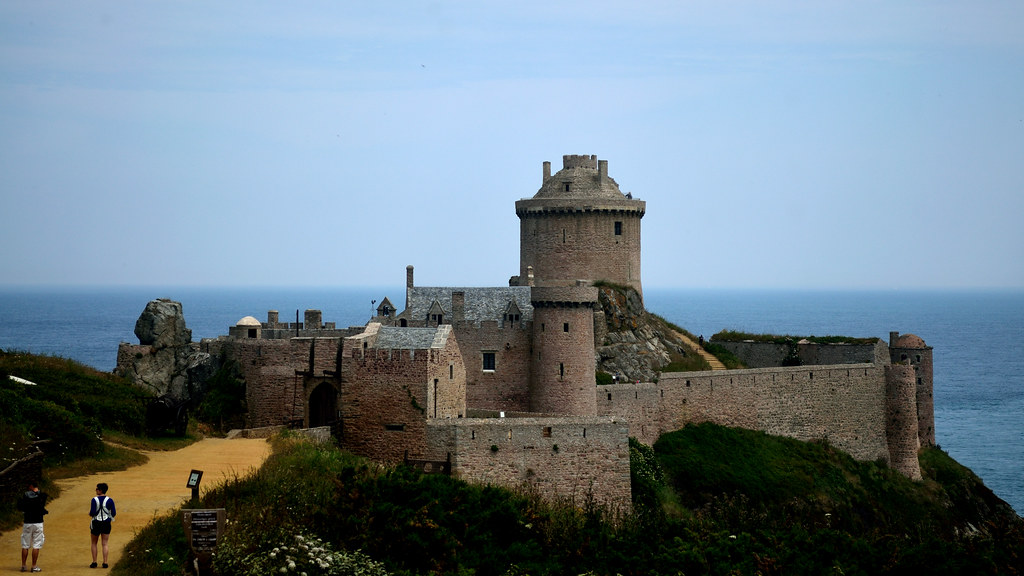
Looking at Fort La Latte and out towards the sea. Cap Fréhel and Fort La Latte day trip

Cap Fréhel & Fort La Latte: Where Brittany Meets Hollywood

35 miles from St Malo | 50min Drive | Fort Entrance €7.80 | GR34 Coastal Walk 4.1km | Vikings 1958 Filming Location | 400-Hectare Nature Reserve

Book Portsmouth to St Malo Ferry →

🏰 Cap Fréhel and Fort La Latte at a Glance

35 miles
Distance from
St Malo
50 minutes
Drive Time
via D976
€7.80
Fort Entrance
(Adult)
4-7 hours
Recommended
Visit Time
  • Dramatic Pink Sandstone Cliffs – 70-metre cliffs rising above the Emerald Coast with panoramic bay views
  • Europe’s Largest Coastal Moorland – 400 hectares of protected heathland with yellow gorse, purple heather, and pink sea thrift
  • Fort La Latte (Château de la Roche Goyon) – 14th-century fortress, Brittany’s most visited castle, never conquered
  • Vikings 1958 Filming Location – Kirk Douglas & Tony Curtis battle scenes filmed on the ramparts
  • GR34 Coastal Path – Spectacular 4.1km clifftop walk between both sites (50-minute walk)
  • Two Historic Lighthouses – Old lighthouse (14th century, Vauban era) and New (1950, 32m tall, 103m above sea)
  • Exceptional Birdwatching – Nesting colonies including rare razorbills, great cormorants, guillemots, and kittiwakes

Why Visit Cap Fréhel and Fort La Latte?

Cap Fréhel and Fort La Latte together deliver some of northern Brittany’s most spectacular coastal scenery — a combination of natural drama and architectural triumph that has captivated visitors for centuries. These two sites sit barely 4 kilometres apart on the windswept Emerald Coast, yet each offers something entirely different: Cap Fréhel is raw natural beauty (pink cliffs, wild moorland, seabird colonies), while Fort La Latte represents seven centuries of unconquered military architecture perched impossibly on rock above the crashing waves.

Pink Cliffs Among Europe’s Most Dramatic

Cap Fréhel is not hyperbole — it genuinely ranks among Europe’s most spectacular coastal headlands. The cape extends into the English Channel between the Bay of Saint-Brieuc and Saint-Malo harbour, with sheer cliffs of pink sandstone and shale rising over 70 metres above the sea. The geology here is exceptional: ancient rocks weathered into layers of red, pink, and grey that glow in the right light, creating a constantly changing palette as sun and clouds move across the sky.

From the clifftop, the views on clear days stretch from Jersey and the Cotentin Peninsula in the east to Paimpol and the Île de Bréhat in the west — a sweeping 180-degree panorama of the Côte d’Émeraude. Below, the sea crashes against the base of the cliffs in constant rhythm, and six small offshore islets provide nesting grounds for thousands of seabirds. This is big, wild coastal scenery — the kind that makes you understand why Brittany has inspired so many artists and writers.

Europe’s Largest Coastal Moorland

The cape protects 400 hectares of coastal heathland — among the largest in Europe and one of the most ecologically important in France. This is not manicured parkland: it’s wild, windswept moorland that transforms dramatically through the seasons. In spring (April-June), the landscape explodes with bright yellow gorse and pink sea thrift — a combination so spectacular it stops first-time visitors in their tracks. In summer (July-August), purple heather carpets the headland, creating what looks like a lavender field by the sea.

The moorland is a protected nature reserve managed by the Conservatoire du littoral. Walking the paths through the heather, with the sea on one side and purple flowers stretching to the horizon on the other, is among Brittany’s great natural experiences. The combination of maritime climate, thin acidic soils, and constant Atlantic wind creates conditions where specialized plants and insects thrive — making this one of Europe’s rarest coastal ecosystems.

An Exceptional Seabird Reserve

Cap Fréhel is one of Brittany’s most important seabird sites. The cliffs and six offshore islets host nesting colonies of great cormorants, European herring gulls, kittiwakes, common guillemots, and — most notably — one of Brittany’s few razorbill colonies (only about 20 pairs, making every sighting significant). Between May and October, the air above the cliffs is constantly filled with wheeling birds, and the cacophony of calls echoes from the rock faces.

For birdwatchers, this is exceptional territory. The LPO (Ligue pour la Protection des Oiseaux) runs guided birdwatching sessions during peak nesting season. Even casual visitors will be struck by the sheer numbers and variety — binoculars are strongly recommended. The sight of razorbills diving for fish, cormorants returning to nests with beakfuls of seaweed, and gulls defending their territory is endlessly fascinating.

Fort La Latte: Seven Centuries of Unconquered History

Fort La Latte (officially Château de la Roche Goyon) occupies one of the most dramatic castle sites in France. Built of local pink sandstone in the 14th century by Etienne Goyon, Lord of Matignon, the fortress perches on a narrow rocky cape extending into the sea. The approach involves crossing two successive drawbridges — the second offering that iconic photograph with Fort La Latte ahead and Cap Fréhel lighthouse in the distance.

Between 1690 and 1715, the military genius Vauban (Louis XIV’s chief military engineer) transformed the medieval castle into a state-of-the-art coastal defence fort. Vauban added artillery platforms, redesigned the fortifications for gunpowder warfare, and integrated the castle into his network of coastal defences protecting France from English and Dutch attack. The fort’s strategic position gave unobstructed views across the English Channel — perfect for early warning of approaching enemy fleets.

Despite being besieged multiple times, Fort La Latte never fell to enemy forces. The English tried repeatedly; they failed every time. This military success, combined with the fort’s spectacular setting, earned it recognition as a Historic Monument in 1925. Since 1931, the Joüon des Longrais family have owned and painstakingly restored the castle, preserving its complete defensive system: drawbridges, keep, chapel, guard house, dungeons, medieval garden, and Vauban’s cannon platforms. Today, Fort La Latte is Brittany’s most visited castle.

Hollywood Comes to Brittany: The Vikings (1958)

In 1958, Fort La Latte became an international film star. Director Richard Fleischer was shooting The Vikings, an epic adventure starring Kirk Douglas (who also produced), Tony Curtis, Janet Leigh, and Ernest Borgnine. The film was primarily shot in Norway’s spectacular fjords, but Fort La Latte was chosen to portray King Aella’s castle for the climactic battle scenes.

The castle’s dramatic position made it perfect for the film’s finale. Kirk Douglas and Tony Curtis performed their own stunts on the ramparts — including the famous sword fight — with the Atlantic crashing 70 metres below. Douglas also insisted on doing the dangerous “running the oars” stunt himself (leaping from oar to oar along a Viking longship). He nailed it in one take, and it’s caught on film.

The Vikings was a major box office success: $6.2 million in the US, $7 million overseas, and the third most popular film at the British box office in 1958. Kirk Douglas took 60% of profits instead of a salary and earned an estimated $3 million — a fortune in 1958. Today, you can stand exactly where Douglas and Curtis fought, walk the same ramparts, and understand immediately why Fleischer chose this location. The fort looks how a medieval castle should: impregnable, dramatic, and utterly commanding.
Getting to Cap Fréhel and Fort La Latte from St Malo: Complete Guide

Cap Fréhel and Fort La Latte are easily accessible from St Malo by car, making them ideal day trip destinations for ferry passengers and Brittany explorers. The two sites are only 4.1 kilometres apart (9 minutes by car, 50 minutes walking the coastal path), so you can visit both in a single trip.

By Car: The Direct Route (Recommended)

Distance from St Malo to Cap Fréhel: 41 km (25.5 miles)
Drive Time: 50 minutes-1 hour
Route: D137 south, then D766/D786 west via Matignon
Toll Cost: €0 (toll-free route)
Fuel Cost: Approximately €5-7 each way

Step-by-Step Driving Directions:

  1. Leave St Malo heading south: From the port or town centre, follow signs for “Rennes/Dol-de-Bretagne” to join the D137 dual carriageway heading south.
  2. Exit onto D766 at Ploubalay: After approximately 20 minutes (30km), exit the D137 onto the D766 westbound, signposted “Matignon/Fréhel”.
  3. Continue through Matignon: Follow the D786 through this small town. You’re now in rural Brittany — gently rolling farmland and forest.
  4. Final approach to Cap Fréhel: Follow brown tourist signs for “Cap Fréhel” and “Fort La Latte”. The road becomes the D16, leading directly to the cape.
  5. Decide: Cap Fréhel or Fort La Latte first: At the junction 3km before Cap Fréhel, you can turn right for Fort La Latte (4 minutes) or continue straight for Cap Fréhel lighthouse (5 minutes). Most visitors go to Cap Fréhel first.
  6. Parking: Follow signs to the main car park at Cap Fréhel (800m from lighthouse, FREE) or Fort La Latte car park (800m from castle entrance, FREE). Both have ample capacity. Detailed parking information below.

💡 GPS Tip: For Cap Fréhel, set navigation to “Phare du Cap Fréhel” or coordinates 48.6835° N, 2.3167° W. For Fort La Latte, use “Fort La Latte, Plévenon” or 48.6838° N, 2.2848° W. Don’t just search “Cap Fréhel” as this may direct you to the village rather than the cape.

Total return journey costs: Approximately €10-14 fuel, €0 tolls, €0 parking (both sites offer free parking).

By Organised Tour from St Malo

Tour Types: Full-day or half-day guided tours
Cost: €45-90 per person
Inclusions: Transport, guide commentary, sometimes Fort La Latte entrance
Best For: Non-drivers, first-time visitors, those wanting historical context

Several tour operators run departures from St Malo combining Cap Fréhel and Fort La Latte, often adding Dinan as a third stop. Tours typically include round-trip transport, English-speaking guide, 2-3 hours at Cap Fréhel and Fort La Latte combined, and return to St Malo. Some include Fort La Latte entrance tickets (€7.80); others charge this separately. Book through St Malo Tourist Office or major tour operators like Get Your Guide and Viator.

Important Note: No Public Transport

Unlike Cancale or Mont Saint-Michel, there is no reliable public bus service from St Malo to Cap Fréhel or Fort La Latte. This is remote coastal countryside designed for car access. Your options are: rent a car, take a taxi (expensive for round trip — expect €120-150), join an organised tour, or hire a private driver. Having your own car provides maximum flexibility and is strongly recommended.

Combining with Other Destinations

Cap Fréhel and Fort La Latte work beautifully with other northern Brittany highlights:

  • Dinan (30 minutes southeast): Medieval hilltop town with ramparts and half-timbered houses. Easy to combine — many visitors do Cap Fréhel morning, Dinan lunch/afternoon.
  • Dinard (45 minutes east): Belle Époque seaside resort with beaches and clifftop villas. The coastal road via Saint-Cast-le-Guildo is spectacularly beautiful.
  • Mont Saint-Michel (1.5 hours): The abbey and bay. A very full day but doable if you start early.
  • Saint-Cast-le-Guildo (15 minutes): Seaside resort with excellent beaches. Good for beach stop or lunch.

Parking at Cap Fréhel and Fort La Latte: Complete Guide

Both Cap Fréhel and Fort La Latte offer FREE parking, which is genuinely unusual for major French tourist sites. However, the car parks are 800 metres from each attraction, requiring a pleasant walk to reach the lighthouse or castle. Here’s everything you need to know.

Cap Fréhel Parking

Location: Main car park 800m from Phare du Cap Fréhel
Cost: FREE (no charges, ever)
Capacity: Large car park, rarely full even in peak summer
Surface: Gravel and grass
Walk to lighthouse: 10-12 minutes on level paths
Facilities: Toilets, information kiosk, picnic tables

The official car park is well-signposted and impossible to miss. Even on the busiest summer weekends, there’s almost always space. From the car park, a clear gravel path leads 800m to the lighthouses — the walk is level, well-maintained, and part of the experience. Budget 10-12 minutes walking time each way.

Fort La Latte Parking

Location: Car park 800m from Fort La Latte entrance
Cost: FREE
Capacity: Medium car park, adequate capacity
Surface: Gravel
Walk to castle: 15 minutes on winding path, some gentle slopes
Facilities: Toilets near car park

The approach path to the fort is part of the magic — it winds along the rocky cape with increasingly dramatic views of the castle ahead. The fort literally appears to grow from the rock as you approach. The path involves some gentle slopes but is manageable for most fitness levels. Budget 15 minutes from car to castle entrance.

Parking Tips: Avoiding Queues

  • Early arrival wins: In high season (July-August), arrive before 10:30am. Car parks rarely fill completely, but early arrival gets closest parking.
  • Pack supplies: No food or drink available at car parks. Bring water, snacks, and sunscreen.
  • Walking poles helpful: The coastal path has some uneven sections. Useful if you have dodgy knees.
  • Allow time for walking: Many first-time visitors underestimate the 800m walks. Add 30 minutes minimum to visit time for parking-to-site-to-parking.

Fort La Latte Opening Hours & Admission 2026

Period Opening Hours
4 April – 3 May 2026 10:00 – 18:00 daily
4 May – 30 June 2026 10:30 – 18:00 daily
1 July – 31 August 2026 10:00 – 18:00 daily (Peak Season)
1 September – 30 September 2026 10:30 – 18:00 daily
1 October – 11 November 2026 11:00 – 17:00 daily

2026 Admission Prices

Adults: €7.80
Students (with card): €6.50
Children (5-17 years): €5.50
Children under 5: FREE
Audio guide: Included via wivisites.com

Closed: 25 December and 1 January
Note: Dogs allowed on leads. Partially accessible for wheelchairs (main courtyard and some areas; dungeon, chapel not accessible)

Fort La Latte: Exploring Brittany’s Most Visited Castle

Fort La Latte is the jewel of this day trip — a magnificently preserved medieval fortress transformed by Vauban into a coastal defence bastion. Allow minimum 1.5 hours for a thorough visit (longer if you’re a history buff or want to soak in the views from the ramparts).

The Approach and Drawbridges

The castle entrance involves crossing two successive drawbridges over natural chasms. The defensive brilliance is immediate — attackers would be completely exposed, with defenders raining arrows from above. The iconic photograph is taken from the second drawbridge looking back towards Cap Fréhel.

The Keep (Donjon)

The keep dates from 1365-1370. Climbing involves steep, narrow stone spiral stairs, but the reward at the top is exceptional: 360-degree panoramic views across the bay and coastline. From here you understand why it never fell — the rock is nearly impossible to approach.

Vauban’s Cannon Platforms

Between 1690-1715, Vauban added artillery platforms with heavy cannon. These platforms sit spectacularly on the seaward side with unobstructed fields of fire. The cannonball oven (for heating shot red-hot before firing at wooden ships) is particularly fascinating.

The Vikings (1958): Film Location

Kirk Douglas and Tony Curtis filmed their famous sword fight on these very ramparts. Both actors performed their own stunts with the Atlantic crashing 70 metres below. You can walk the same ramparts where these scenes were shot.

Cap Fréhel: Pink Cliffs and Nature Reserve

Cap Fréhel is the natural counterpart to Fort La Latte’s military drama — wild, windswept coastal scenery at its most spectacular. The cape extends into the English Channel, its pink sandstone cliffs rising 70+ metres, protected moorland stretching inland, and two lighthouses standing sentinel above the sea.

The Two Historic Lighthouses

The Old Lighthouse: Built in the 14th century during Louis XIV’s reign by one of Vauban’s engineers. No longer operational but preserved as a historic monument.

The New Lighthouse (Phare du Cap Fréhel): Built in 1950 after German forces destroyed the 1836 lighthouse in 1944. Standing 32 metres tall, its beam reaches 103 metres above sea level and can be seen over 50 kilometres away. Between April and mid-September, you can climb the 145 steps (€3) for spectacular 360-degree views.

Seasonal Wildflower Guide

Spring (April-May-June): Bright yellow gorse and pink sea thrift bloom. The coconut-like scent from gorse flowers is unmistakable. Most photogenic season.

Summer (July-August): Purple heather takes over, carpeting the moorland. Heather blooms peak in August. Combined with pink cliffs and blue sea, the colour palette is overwhelming.

Autumn-Winter: Bronze and rust tones. The cape is at its wildest. Winter storms are spectacular — waves crash over clifftops during the fiercest gales (do NOT visit cliffs in dangerous weather).

Walking the GR34 Coastal Path: Cap Fréhel to Fort La Latte

The GR34 Sentier des Douaniers connects Cap Fréhel and Fort La Latte via 4.1 kilometres of spectacular clifftop walking — arguably one of the finest short coastal walks in northern France. Even if you’re not a dedicated hiker, this section is accessible, well-marked, and genuinely rewarding.

The Route: Practical Details

Distance: 4.1 km one way (8.2 km return)
Walking Time: 50 minutes to 1.5 hours one way (depending on pace)
Difficulty: Moderate — well-maintained, some gentle slopes, no technical sections
Waymarking: Red-and-white GR markers throughout
Surface: Natural path — earth, grass, some rocky sections

Which Direction to Walk?

Most walkers prefer Fort La Latte to Cap Fréhel because the approach to Cap Fréhel along the clifftops is spectacular — the lighthouse grows larger ahead, and you’re walking towards the moorland flowers.

However, Cap Fréhel to Fort La Latte also has merit — the final approach to the castle is genuinely breathtaking, with the fortress appearing perched on its rock ahead.

Essential Walking Tips

  • Footwear: Sturdy walking shoes or hiking boots essential. Path can be muddy after rain.
  • Weather protection: Coastal wind is constant. Bring windproof jacket even on calm days.
  • Sun protection: Zero shade on the path. Sunscreen, hat, sunglasses essential in summer.
  • Water: Carry at least 1 litre per person. No facilities between sites.
  • Safety: Cliff edges have no barriers. Keep children and dogs under close supervision.

Where to Eat Near Cap Fréhel and Fort La Latte

Food options directly at Cap Fréhel and Fort La Latte are extremely limited. The sites are in remote coastal countryside. However, excellent options exist within 10-15 minutes’ drive. Most visitors either pack a picnic or drive to nearby towns for meals.

Budget Option: Picnic (Recommended)

The absolute best “dining” option for Cap Fréhel is a picnic. Both sites have perfect picnic spots: grassy areas at Cap Fréhel with sea views, or clifftop near Fort La Latte with the castle as backdrop. Buy supplies in St Malo before departure (baguettes, cheese, charcuterie, fruit, local cider) and eat with 180-degree ocean views. Cost: €10-15 per person for excellent French picnic ingredients.

Le Petit Galet (Plévenon)

Address: 22 La Latte, Plévenon (on road to Fort La Latte)
Type: Traditional crêperie
Best For: Authentic Breton galettes and sweet crêpes. Quality consistently good, atmosphere relaxed, prices reasonable (€12-18 for galette, crêpe, cider). Very popular in summer — arrive early or book ahead.

Audineau Alain at Port à la Duc

Type: Direct-from-source seafood seller
Best For: Fresh oysters, langoustines, crab — ultra-fresh and cheap. You’re buying directly from the person who caught it. Oysters exceptional and far cheaper than restaurant prices. Pair with Breton cider. Very casual — plastic tables, no frills.

Sample Itineraries: Half-Day and Full-Day Trips

Whether you have 4 hours or a full day, here are tested itineraries that maximise your Cap Fréhel and Fort La Latte experience.

Half-Day Express (4-5 Hours Total)

Perfect for: Ferry passengers, those combining with other destinations, limited time

  • 9:00-9:50am — Drive to Cap Fréhel: Leave St Malo. Arrive Cap Fréhel car park by 9:50am.
  • 9:50-11:30am — Cap Fréhel Exploration: Walk to lighthouses. Explore the cape: new lighthouse (climb if open), clifftop circuit, moorland paths, seabird viewing.
  • 11:30am-12:00pm — Drive to Fort La Latte: 9 minutes to Fort La Latte car park.
  • 12:00-1:30pm — Fort La Latte Visit: Walk to castle entrance (15 mins). Buy admission (€7.80). Explore thoroughly: keep, ramparts, Vikings filming location. Allow 1.5 hours.
  • 1:30-2:30pm — Return to St Malo: Drive back (50 mins). Arrive St Malo 2:20pm.

Full Day with GR34 Walk (7-8 Hours)

Perfect for: Hikers, photographers, comprehensive experience

  • 8:30-9:20am — Drive to Fort La Latte: Early departure. Arrive 9:20am. You’ll walk TO Cap Fréhel and back.
  • 9:30-11:00am — Fort La Latte Visit: Opens 10:00 or 10:30. Explore thoroughly: keep, ramparts, dungeons, cannon platforms.
  • 11:00am-12:00pm — GR34 Walk to Cap Fréhel: Clifftop walking, seabird viewing, moorland scenery. Allow 1 hour with photos.
  • 12:00-1:00pm — Picnic Lunch at Cap Fréhel: Grassy spot with sea views. Unpack picnic bought in St Malo.
  • 1:00-2:30pm — Cap Fréhel Exploration: Lighthouses, clifftop circuit, seabirds, moorland paths.
  • 2:30-3:30pm — GR34 Return Walk: Retrace route. View approaching Fort La Latte is spectacular.
  • 3:30-4:30pm — Return to St Malo: Drive back. Arrive 4:20pm.

Top Tips for Your Cap Fréhel and Fort La Latte Day Trip

  • Check weather and wind forecast: Cap Fréhel is extremely exposed. Wind speeds can be 50%+ higher than St Malo. Check marine weather forecasts before departure.
  • Pack windproof layers: Coastal wind is relentless. Even on warm days, bring windproof jacket. Wind chill can make temperatures feel significantly cooler.
  • Wear appropriate footwear: If walking GR34, boots or sturdy trail shoes essential. Flip-flops or fashion trainers inappropriate.
  • Bring binoculars: Essential for birdwatching (seabirds on offshore islets) and appreciating distant views. Transforms the experience.
  • Time visit for wildflowers: April-June for yellow gorse and pink sea thrift; July-August for purple heather.
  • Start at Fort La Latte if visiting both: Fort has limited opening hours. Cap Fréhel accessible 24/7. Visit fort first to ensure you catch opening hours.
  • Allow time for Fort La Latte: Many underestimate how long they’ll spend. Budget minimum 1.5 hours; serious history buffs may spend 2-3 hours.
  • Picnic is genuinely best option: Rather than limited on-site refreshments or driving to restaurants, embrace French picnic tradition. Quality St Malo ingredients, dramatic clifftop setting, zero crowds.

Cap Fréhel and Fort La Latte: Frequently Asked Questions

Is Cap Fréhel and Fort La Latte worth visiting from St Malo?

Absolutely yes. Cap Fréhel and Fort La Latte together deliver some of the most spectacular coastal scenery in northern Brittany — dramatic pink cliffs, wild moorland, and a perfectly preserved medieval fortress. The 50-minute drive from St Malo is rewarding for half-day or full-day trips. Even visitors who’ve seen major European castles consistently rate Fort La Latte among their highlights.

How long should I spend at Cap Fréhel and Fort La Latte?

Minimum 4-5 hours for worthwhile visit including travel time. Ideally, plan for 6-8 hours to include GR34 coastal walk (4.1km, 50 minutes each way), longer fort exploration, and picnic lunch. Serious hikers and photographers may want full day (8-10 hours). Half-day trips (4-5 hours) require efficient time management.

Do I need to book Fort La Latte tickets in advance?

No. Fort La Latte operates ticket office at castle entrance where you buy admission on arrival (€7.80 adults). No online booking system. Queues typically short even in peak summer — perhaps 10-15 minutes maximum on busiest days. Most days you walk straight to ticket window.

Can I visit without a car?

Very difficult. No regular public bus service from St Malo. Options: organised tours (€45-90 per person), private taxi (expensive, €120-150+), or rent car. Having your own car provides maximum flexibility and is strongly recommended.

What is Fort La Latte famous for?

Fort La Latte is famous for several reasons: Brittany’s most visited castle due to spectacular clifftop setting; served as King Aella’s castle in 1958 film The Vikings (Kirk Douglas/Tony Curtis sword fight on ramparts); perfectly preserved Vauban coastal fortress (1690-1715); never fell to enemy forces across seven centuries despite repeated English sieges.

When is the best time of year to visit?

Best overall: May-June or September — pleasant weather, moorland wildflowers (gorse/sea thrift May-June, late heather September), moderate crowds. Best for purple heather: July-August (peak bloom mid-August). Cheapest and quietest: November-March — fort reduced hours, weather unpredictable, moorland dormant, but genuinely wild atmosphere. Cap Fréhel spectacular year-round but seasonal wildflowers make spring and summer particularly rewarding.

Where was The Vikings (1958) filmed?

The Vikings was primarily filmed in Norway’s fjords (Maurangerfjorden, Nærøyfjord) for Viking village and longboat scenes. However, Fort La Latte in Brittany served as King Aella’s castle for climactic battle scenes. Kirk Douglas and Tony Curtis filmed sword fight on Fort La Latte’s ramparts. Castle siege shot here using actual fortress. Combination of Norwegian fjords and French coastal fortress created film’s distinct visual impact.

Is parking available at both sites?

Yes — both offer FREE parking, unusual for major French tourist sites. Cap Fréhel: large car park 800m from lighthouse (10-min walk, FREE, rarely full). Fort La Latte: car park 800m from castle entrance (15-min walk, FREE, adequate capacity). Walks from car parks to sites part of experience — dramatic approaches with building anticipation. Free year-round, no time limits.

Can you walk from Cap Fréhel to Fort La Latte?

Yes — highly recommended. GR34 Sentier des Douaniers connects both via 4.1km spectacular clifftop walking (approximately 50 minutes to 1.5 hours one-way). Path well-marked with red-and-white GR waymarkers, open year-round, completely free. Many visitors consider this coastal walk the highlight — exceptional views, moorland wildflowers in season, constant sea panoramas. Return same way (8.2km total) or arrange car shuttle.

How far is Cap Fréhel from St Malo?

Cap Fréhel is 41 kilometres (25.5 miles) from St Malo by road via D137 and D786. Drive takes 50 minutes to 1 hour in normal traffic with no tolls. Route passes through rural Brittany — pleasant countryside driving. Cap Fréhel one of furthest major day trips from St Malo (Mont Saint-Michel slightly closer at 35 miles), but journey straightforward and rewarding.

Continue Planning Your Portsmouth to St Malo Trip

🛏️

Ferry Cabin Guide

Every cabin grade on MV Saint-Malo and Armorique

Cabins Guide →

Ferry Timetable

Full 2026 sailing schedule and departure times

Timetable →

Portsmouth Port Guide

Parking, facilities, check-in and EV charging

Port Guide →

🗺️

St Malo City Guide

Ramparts, beaches, restaurants and attractions

St Malo Guide →

Plan Your Cap Fréhel & Fort La Latte Adventure

Book your Portsmouth to St Malo crossing with Brittany Ferries and discover the dramatic pink cliffs and medieval fortress of Cap Fréhel and Fort La Latte.

Check Ferry Prices & Availability →