Cancale Day Trip from St Malo: Complete 2026 Guide to Brittany’s Oyster Capital

Just 15 miles east of St Malo along the Côte d’Émeraude lies Cancale — a small Breton fishing port that has become one of the most celebrated seafood destinations in France. This is Brittany’s oyster capital, where 400 hectares of oyster beds stretch across the bay of Mont Saint-Michel in orderly rows, where oyster farmers have worked the same tidal waters for generations, and where you can eat some of Europe’s finest shellfish straight from the sea for as little as €6 a dozen. That single extraordinary fact — fresh oysters, standing at a harbourside stall, shucked to order and eaten looking out over Mont Saint-Michel — is enough reason to visit. But Cancale offers considerably more: dramatic coastal walking on the GR34 Sentier des Douaniers, the wild clifftop headland of Pointe du Grouin, an authentic working fishing harbour in Port de la Houle, and that particular atmosphere of a town that still belongs to the sea rather than to tourism.

Cancale sits at the western edge of Mont Saint-Michel bay, a position that shapes everything about it. The bay here has one of the largest tidal ranges in Europe — up to 14 metres at spring tides — which creates the exceptional plankton-rich conditions that make Cancale oysters so prized. When Louis XIV wanted oysters at Versailles, he had them shipped from Cancale. When modern chefs from Paris to Tokyo specify Brittany oysters, they often mean Cancale. Since November 2019, the traditional oyster-farming knowledge of Cancale has been inscribed on UNESCO’s list of Intangible Cultural Heritage — the only oyster-producing region in the world to receive this recognition.

This complete 2026 guide covers everything needed for the perfect Cancale day trip from St Malo: verified driving and bus directions, full parking guide with free options, the oyster market explained from first principles, coastal walking routes, Pointe du Grouin, the fishing harbour, where to eat (from €6 market stalls to sit-down restaurants), the oyster farm tour, and a practical itinerary for making the most of 3-5 hours.

Last updated: March 2026 | All prices, times, and details verified from official sources

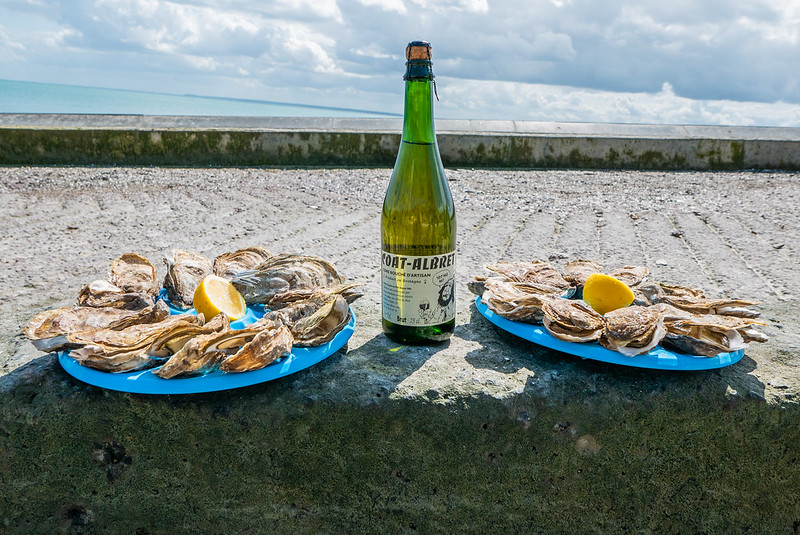
Oysters and Wine on a Cancale day trip

Cancale: Brittany’s Oyster Capital

15 miles from St Malo | 25 min Drive | Oysters from €6/dozen | UNESCO Heritage Oyster Farming | Spectacular Mont Saint-Michel Bay Views

Check Ferry Prices & Availability →

🦪 Cancale Day Trip at a Glance

15 miles
Distance from
St Malo
25 minutes
Drive Time
via D201
€6
Oysters from
per dozen
3-5 hours
Recommended
Visit Time
  • Marché aux Huîtres – Open every day of the year, 8 producers, oysters shucked to order from €6/dozen
  • UNESCO Heritage Oyster Farming – The only oyster-farming tradition in the world with this recognition (since 2019)
  • Port de la Houle – Working fishing harbour where oyster boats dock at low tide; authentic Breton atmosphere
  • Sentier des Douaniers (GR34) – Spectacular clifftop coastal path with views across Mont Saint-Michel bay
  • Pointe du Grouin – Wild headland with 360° panorama over the bay; one of Brittany’s great viewpoints
  • La Ferme Marine – Guided oyster farm tour including tasting; excellent for families and food lovers

Why Visit Cancale from St Malo?

Cancale is one of those rare places where the thing it’s famous for — oysters — is genuinely the best in the world, and you can eat them for almost nothing standing at a harbour stall. That combination of world-class food at market prices, in an authentic working port with spectacular coastal scenery, is what makes Cancale a truly unmissable day trip from St Malo.

The World’s Greatest Oysters — and Why Cancale Produces Them

The bay of Mont Saint-Michel is not just a scenic backdrop — it is the reason Cancale exists as an oyster capital. The bay’s exceptional tidal range (up to 14 metres, among the largest in Europe) creates a twice-daily cycle of immense volumes of Atlantic water flooding across 400 hectares of oyster beds. This constant flushing brings extraordinary quantities of phytoplankton — the microscopic algae that oysters filter-feed on. Cancale oysters grow fat, flavourful, and deeply iodic on this natural richness. The same plankton bloom that feeds millions of birds on the bay’s mudflats feeds the oysters that have made this small port world-famous.

The oyster beds here cover approximately 7.3 square kilometres of the bay floor, producing around 25,000 tonnes of oysters per year — figures that reflect the extraordinary productivity of these tidal waters. The result is what connoisseurs call the Perle Cancalaise (Cancale Pearl) — oysters with a powerful, clean sea flavour, high salinity, and a distinctive mineral finish. Louis XIV was so fond of them that he reportedly had runners sprint them overnight to Versailles. Today, oyster farmers in Cancale supply Michelin-starred restaurants across France and Japan. Yet at the Marché aux Huîtres on the port, you can eat these same oysters for €6–€9 a dozen, shucked before your eyes, eaten on the harbour wall with Mont Saint-Michel on the horizon. This is one of the great affordable food experiences in Europe.

A Town Still Shaped by the Sea

Unlike many Breton coastal towns that have surrendered to tourism, Cancale remains genuinely shaped by its relationship with the sea. At low tide, watch the queue of tractors head out across the exposed mudflats to work the oyster tables — a daily spectacle that has defined this town for centuries. Port de la Houle empties dramatically at low tide, revealing the boats settled on the sand and the geometry of thousands of oyster tables stretching toward the horizon. The fishermen’s cottages, the stacked lobster pots, the salt-weathered faces in the harbourside cafés — Cancale is not performing authenticity, it simply is authentic. This is what a working Breton fishing port actually looks like.

Gateway to Spectacular Coastal Scenery

Cancale sits on the GR34 Sentier des Douaniers — the famous customs officers’ path that runs along the entire Breton coastline. The section from Cancale north to Pointe du Grouin is among the finest coastal walking in Brittany: clifftop paths above the Côte d’Émeraude, views south across the bay to Mont Saint-Michel, small coves and beaches at Port-Mer and Port-Pican, and the wild headland of Pointe du Grouin where you can see simultaneously back to St Malo and forward across the Channel Islands. Pointe du Grouin is also one of Brittany’s most important seabird sites — the Île des Landes just offshore hosts the largest colony of great cormorants in Brittany. For walkers, nature lovers, and anyone who wants more than oysters, Cancale delivers emphatically.

Getting to Cancale from St Malo: Complete Guide

Cancale is the most accessible of the major day trips from St Malo — just 15 miles (24km) along the coast. By car it’s a simple 25-minute drive. The bus takes 17–35 minutes depending on which service you catch.

By Car: The Direct Route

Distance: 15 miles (24 km)
Drive Time: 25 minutes
Route: D201 via Paramé and Saint-Méloir-des-Ondes
Toll Cost: €0 (no tolls)
Fuel Cost: Approximately €2–3 each way

Step-by-Step Directions from St Malo:

  1. Leave St Malo: Head east on the D201 (Route de Cancale), signposted from the port and town centre. The road runs east through the beach suburb of Paramé, passing Plage du Sillon.
  2. Through Saint-Méloir-des-Ondes: Continue on the D201 through this small town. The road is straightforward and well-signposted throughout. The surrounding countryside is flat agricultural land — very easy driving.
  3. Arrive in Cancale: You’ll descend into Cancale with the bay opening up ahead. Follow signs for “Port de la Houle” (the lower harbour) or “Centre Ville” (upper town).
  4. Parking: For free parking, follow signs to “Parking du Port” (upper free car park, 10-minute walk to harbour) rather than the paid seafront car parks which fill by 11am. Full parking details in the section below.
  5. Scenic alternative: The coast road via Rothéneuf adds 10–15 minutes but is significantly more beautiful — it hugs the Côte d’Émeraude with sea views all the way. Worth it if you’re not in a hurry.

💡 GPS Tip: Set navigation to “Parking du Port, Cancale” or “Marché aux Huîtres, Cancale” — this brings you directly to the harbour area. Avoid following “Centre Ville” signs if you want to start at the oyster market, as the town centre is up the hill from the port.

Total journey costs return: Approximately €4–6 fuel, €0 tolls, plus parking (free options available — see below).

By Bus: MAT Line 5 (Saint-Malo Agglomération)

Service: MAT Line 5 (Saint-Malo Agglomération)
Journey Time: 17 minutes direct
Frequency: Every 30 minutes
Departs: Croix Désilles, St Malo
Arrives: La Poste, Cancale
Best For: Non-drivers, those who want to avoid parking hassle

The MAT Line 5 bus runs every 30 minutes every day between St Malo and Cancale, making Cancale one of the most easily accessible day trips by public transport. At just 17 minutes from Croix Désilles to Cancale’s La Poste stop, this is faster and cheaper than driving if you factor in parking costs. The route passes through Saint-Méloir-des-Ondes. Check current timetables and fares at www.mat-maloagglomeration.fr.

Advantages: No parking stress, very frequent service, drop near town centre, eco-friendly, great value
Disadvantages: La Poste stop is in the upper town — Port de la Houle is a 10-minute walk downhill (and uphill on return). Less flexible than car for combining with Pointe du Grouin.

Note: There is also a seasonal “Ligne des Plages” (Line 8) service in high season running along the coast via Rothéneuf, which offers a more scenic journey to Cancale in summer.

Combining Cancale with Mont Saint-Michel

Cancale and Mont Saint-Michel sit at opposite ends of the same bay and are only 30 minutes apart by car (via the D155). Many visitors make a single day of both — oysters at Cancale in the morning, Mont Saint-Michel in the afternoon. The drive between them passes through beautiful salt-meadow countryside where the famous pré-salé lamb graze (the same sheep that give Mont Saint-Michel’s lamb its distinctive flavour). This is an excellent combination if you have a car and want to maximise your time on the bay.

Parking in Cancale: Complete Guide with Free Options

Parking in Cancale requires some planning — the seafront car parks along Port de la Houle fill up by 11am in summer and are all paid. However, free options exist and are well worth using. The key insight: park free at the top of town and walk 10 minutes down to the harbour.

FREE Parking Options 2026

Parking du Port (Best Free Option — Recommended by the Oyster Market itself)

Location: Upper town, near the Tourist Information Office
Cost: FREE
Walk to harbour: 10 minutes downhill (and uphill on return)
Tuk-Tuk service: Available in season — take the tuk-tuk down, walk back (or vice versa)
Best For: All visitors. The Marché aux Huîtres website specifically recommends this car park and notes you can enjoy bay views on the walk down.

Place de l’Église (Around the Church)

Location: Upper Cancale, near Église Saint-Méen
Cost: FREE (limited spaces — 54 places)
Walk to harbour: 10–12 minutes
Best For: Early arrivals who want to combine parking with a visit to the upper town and museum

Parking Vallée des Jeux (Overflow/Relief Car Park)

Location: Relief car park, upper town
Cost: FREE
Capacity: 200 spaces
Best For: Peak season when other free parking is full

Paid Parking: Seafront and Harbour Car Parks 2026

If you prefer to park closer to the harbour (accepted trade-off: you pay), these are the main seafront options, with verified rates from the official Saint-Malo Bay Tourism authority:

Car Park Low Season Rate High Season Rate Spaces
Parking Duguay Trouin (near port) €1.20/hr €1.60/hr 92
Quai Kennedy (seafront) €1.20/hr €1.60/hr 60
Parking Gambetta €1.20/hr €1.60/hr 108
Parking Chemin Neuf €0.80/hr €1.20/hr 116
Aire de la Ville Ballet (near port, motorhomes) €2/hr flat €12/24hr At port

High season = summer months. Low season = autumn/winter/spring. Overstaying without paying incurs a €32 Forfait Post-Stationnement. Disabled badge holders: free dedicated spaces at all car parks.

Parking Tips: How to Avoid the Queues

  • Arrive before 10:30am: Seafront car parks fill very quickly from late morning in summer. Arrive early and you’ll find a space easily. Post-lunch arrivals (12pm+) often find everything full.
  • Use the free Parking du Port: It’s free, it always has spaces, and the 10-minute walk offers beautiful bay views. This is what the official oyster market website recommends.
  • Try the Tuk-Tuk: The “Le TukTuk du Port” service runs from the upper free car park down to Port de la Houle and back. Perfect if you’d rather not walk both ways — take the tuk-tuk down, walk back up after oysters.
  • Park near the church: Several locals tip the free spaces around Église Saint-Méen in the upper town as a quieter alternative. It’s a similar walking distance to the harbour.
  • Consider the bus: On summer weekends when parking is chaotic, the MAT Line 5 bus every 30 minutes from St Malo is genuinely the easier option.

The Marché aux Huîtres: Cancale’s Famous Oyster Market

The Marché aux Huîtres is, quite simply, one of the finest food experiences in France. At the end of Port de la Houle, beneath the lighthouse, eight family-run oyster producers set up stalls every single day of the year — rain, wind, sun, or snow — and sell their Cancale oysters directly from the water to you. This is unique in France: you are buying from the actual oyster farmer, metres from the beds where the oysters were grown, in one of the world’s most productive oyster bays.

What to Expect at the Market

Location: End of Port de la Houle, under the Houle lighthouse (Phare de la Houle)
Open: Every day of the year, morning to evening
Payment: Card, cheque, or cash accepted at all stalls
Accessibility: Level access, suitable for pushchairs and wheelchairs. Dedicated seating table for visitors with reduced mobility. Benches along Rue des Parcs.

Eight family oyster producers operate the market’s blue-and-white striped stalls. Each farm has its own character and its oysters reflect subtle differences in their growing beds. You can buy by the half-dozen, dozen, or larger quantities. The producers will shuck your oysters for you on the spot — a proper shucking knife and practised hands produce perfectly opened shells in seconds. Your oysters arrive on a simple tray with a wedge of lemon.

Take your tray to the harbour wall or the steps and eat with the view ahead of you. The Cancale tradition — followed by locals and visitors alike — is to throw your empty shells back onto the beach below, adding to the centuries-old layers of discarded shells that have built up here. You’ll see others doing it; it’s not littering, it’s participation in something genuinely old. A small van nearby sells wine by the glass — a glass of cold Muscadet or dry Breton cider with your oysters is the perfect accompaniment.

Oyster Prices at the Market 2026

Oyster Type / Size Price Range Notes
Creuse (hollow) No. 3 or 4 — medium €6–€7/dozen Best starting point; great flavour, easy to eat
Creuse (hollow) No. 1 or 2 — large €7–€9/dozen Bigger and meatier; stronger sea flavour
Plate (flat/Belon) €8–€12/dozen Rarer, nuttier flavour; the connoisseur’s choice
Pied de Cheval (giant native oyster) Market price The famous giant Cancale oyster — ask at stalls for availability

Note: Prices verified from multiple recent visitor reports (2025–2026) and review data. Prices may vary slightly between producers and by season. Numbers on oysters indicate size: the higher the number, the smaller the oyster. No. 3 is the most popular size for first-time visitors.

Oyster Eating Guide for First-Timers

  • Start with a No. 3: Medium-sized, the most flavourful and approachable. Try a half-dozen first if you’re new to oysters.
  • Lemon or not? The French tradition is without — purists say lemon masks the oyster’s own flavour. Try your first one plain, then add lemon to the rest if you prefer. A shallot and wine vinegar mignonette sauce is the classic accompaniment if offered.
  • Check the oyster is alive: A live oyster will flinch when you touch it with a fork or the tip of your finger. If it doesn’t move at all, don’t eat it — though at the Marché aux Huîtres this is essentially never an issue given the speed of turnover.
  • Visit at low tide: The market operates year-round but the view is most dramatic at low tide when the vast oyster beds are exposed — an extraordinary landscape stretching toward Mont Saint-Michel.
  • Year-round eating: The old rule about only eating oysters in months with an “R” no longer applies — many Cancale producers grow sterile triploid oysters that don’t produce summer roe, so you can eat excellent non-milky oysters in July and August too.

Port de la Houle: The Working Fishing Harbour

Port de la Houle is the beating heart of Cancale — the lower harbour where the fishing and oyster boats dock, where the restaurants line the quayside, and where the drama of the tides plays out daily. It’s a genuinely working port, not a gentrified marina, and that authenticity is its greatest appeal.

The Extraordinary Tides of Cancale

The tidal range at Port de la Houle is among the largest in France — up to 14 metres at spring tides. This means that the entire harbour transforms completely twice a day. At high tide, boats float at the quayside, the bay is a shimmering expanse of water, and Mont Saint-Michel appears to float in the middle distance. Two or three hours later, the water has retreated hundreds of metres, the boats are settled on sand or mud, and the 400 hectares of oyster beds emerge as a geometric landscape of parallel rows stretching toward the horizon.

At low tide, the daily spectacle begins: a procession of tractors queues on the jetty, then drives out across the exposed seabed to work the oyster tables — the same “ballet des ostréiculteurs” (oyster farmers’ ballet) that has defined Cancale for centuries. Check the tide times before you visit at tide-forecast.com — both states of the tide are spectacular, but for different reasons. High tide gives you the mirror bay; low tide gives you the extraordinary scale of the oyster beds and the tractor procession.

The Quayside Promenade

The Boulevard du Général de Gaulle runs along the waterfront above Port de la Houle, lined with more than 50 seafood restaurants and crêperies. This is the main social hub of Cancale — a pleasant evening stroll even without eating. The views across the bay to Mont Saint-Michel at sunset are exceptional. At the far end of the promenade, the Marché aux Huîtres sits beneath the lighthouse.

Les Laveuses d’Huîtres (The Oyster Washers)

A poignant monument at the harbour to the women who traditionally sorted, washed, and packed the oysters — exhausting cold work done without gloves. The laveuses d’huîtres (oyster washers) were a central figure in Cancale’s social history, and this memorial acknowledges their contribution to the town’s prosperity. Free to visit; worth a few minutes of contemplation.

Les Viviers de la Houle

The working shellfish viviers (holding tanks) at the harbour where lobsters, crabs, and other live shellfish are stored before sale. You’ll see the crates and tanks as you walk the port — another reminder that this is a functional fishing harbour, not a decorative one. Several restaurants draw directly from these viviers for the freshest possible catch.

Sentier des Douaniers: Coastal Walking from Cancale

The GR34 Sentier des Douaniers (Customs Officers’ Path) passes directly through Cancale, and the section from Port de la Houle north to Pointe du Grouin is one of the finest short coastal walks in Brittany. Even a short section delivers dramatic clifftop views, hidden coves, and the extraordinary sight of the bay opening up toward Mont Saint-Michel.

Cancale to Pointe du Grouin: The Main Walk

Distance: 7km one way (Port de la Houle to Pointe du Grouin) — approximately 11km return
Walking Time: 3.5–5 hours return (including stops)
Difficulty: Moderate — well-marked path, some gentle climbs, no technical sections
Cost: FREE — the path is fully open and free to walk
Markings: Red and white waymarks of the GR34 throughout

The path leaves Port de la Houle heading north, quickly climbing above the oyster beds before following the cliff edge. Along the way you pass: the small cove of Plage du Verger (good for a summer swim), the sheltered inlet of Port-Mer (a quieter beach away from the crowds), the peaceful Port-Pican and Port-Briac fishing coves, and finally arrive at the dramatic headland of Pointe du Grouin. The path is extremely well-marked and signposted throughout.

The vegetation on this section reflects a remarkable microclimate — sheltered from the prevailing wind by the headland, this eastern stretch of the coast enjoys almost Mediterranean conditions. Maritime pines, mimosa, and golden gorse create unusual Breton scenery. In the right light, it’s been described as “la Provence cancalaise” (Cancale’s Provence). The contrast with the wild clifftops beyond Pointe du Grouin could not be more dramatic.

Plage du Verger

The first beach on the coastal path north of Cancale — a sheltered cove with good swimming in summer. Parking available (paid, seasonal). A natural rest stop 2km from Port de la Houle. Free entry to the beach itself. The Chapelle Notre-Dame du Verger is nearby — a small sailors’ chapel with a long devotional history.

Port-Mer

A small, quiet beach and cove 3.5km from Port de la Houle — a popular alternative to the busy main harbour area. Car parking available here if you want to start the walk at this midway point rather than from Cancale itself. The beach faces north and can be exposed to wind but offers peace in peak season when Cancale port is crowded.

Shorter Walk Option (1 hour)

Short on time? You don’t need to walk the full 7km to Pointe du Grouin. Even 20–30 minutes north along the path from Port de la Houle rewards you with elevated clifftop views across the full bay toward Mont Saint-Michel — views that are genuinely among the best on the Côte d’Émeraude. Walk up, take photos, come back for oysters.

Pointe du Grouin: Cancale’s Spectacular Headland

Pointe du Grouin is one of Brittany’s great viewpoints — a jutting rocky headland 10km north of Cancale where the land ends dramatically and the views in every direction are extraordinary. It’s reachable on foot via the Sentier des Douaniers, or by car in 15 minutes from Cancale (D201 north).

What to See at Pointe du Grouin

From the tip of Pointe du Grouin, the views are genuinely 360°. To the south across Mont Saint-Michel bay, you can see the abbey on clear days — a small golden shape far across the water, impossibly far from the sea that surrounds it at high tide. To the west, the Côte d’Émeraude stretches toward Cap Fréhel and the Channel Islands of Jersey and Guernsey are visible on good days (Jersey is only 35km away). To the east, the Norman coast disappears toward the horizon. Below, the sea crashes against pink granite cliffs and the dramatic geology of the headland is exposed in every direction.

Just off the headland lies the Île des Landes, a small uninhabited island that is Brittany’s most important seabird colony: the largest great cormorant colony in Brittany nests here, along with shags, herring gulls, and other coastal species. In season, SEPNB naturalists run telescope sessions to help visitors identify the birds. The semaphore station at the headland tip is open in summer for maritime surveillance. A WWII bunker near the semaphore retains inscriptions left by German soldiers — a sobering historical detail in an otherwise purely natural setting. Parking at Pointe du Grouin is free (small car park on the approach road).

Getting to Pointe du Grouin

  • By foot (GR34): 7km from Port de la Houle — approximately 2 hours walking. The classic way, with all the coastal views en route. Return the same way or arrange car shuttle.
  • By car: 15 minutes from Cancale via D201 north. Free parking at the headland (follow signs for “Pointe du Grouin”). Park here and do a short circular walk around the headland — 45–60 minutes and highly rewarding even without the full coastal walk.
  • Combined strategy: Drive to Pointe du Grouin first, do the circular headland walk, then drive back to Cancale for oysters. Alternatively, take the GR34 one way and arrange to be collected from the other end.

La Ferme Marine: Cancale’s Oyster Farm Tour

For a deeper understanding of how Cancale’s world-famous oysters are grown, La Ferme Marine offers guided tours of a working oyster farm (Les Parcs Saint-Kerber) in a spectacular setting overlooking Mont Saint-Michel bay. This is an excellent option for families, food lovers, or anyone who wants to go beyond simply eating the oysters to understanding what makes them exceptional.

What the Tour Includes

Duration: Approximately 1 hour
Language: French year-round; English tours available in July–August
Booking: No prior reservation needed for standard visits
Recognition: Recognised by the Collège Culinaire de France as “Artisan Producer of Quality” (jury co-chaired by Alain Ducasse)

The guided tour begins with a documentary film about oyster farming in Cancale, then moves to the working workshops where you can see oysters being sorted, cleaned, and packaged. The guide explains the complete oyster lifecycle — from spat collection to three or four years later when they’re ready to eat — and the challenges of working with the extreme tides of Mont Saint-Michel bay. The tour ends with an oyster tasting, where you try both flat (Belon-style) and hollow (creuse) varieties with a glass of white wine.

An additional highlight is the extraordinary shell museum — 1,500 species from five continents displayed in a dedicated room. This alone is worth the admission for anyone interested in marine natural history. The farm’s shop sells oysters to take away, along with local products. Note: the site is on a steep slope; wheelchair users need to be accompanied and use a non-electric chair.

La Ferme Marine: Practical Information 2026

  • Website: www.ferme-marine.com
  • Tours: Monday–Friday at 3pm (French); July–mid-September additional tour at 2pm (check for English dates)
  • Admission: Adults €9.70 | Children 5–14 years €5.70 | Students €7.70 (student card required) | Family 2+2 €28.00 | Family 2+3 €31.00 | FREE under 5
  • Best visited: At low tide — when the oyster beds are exposed and visible from the farm
  • Note: Pets not permitted on site (even in arms). Bring footwear suitable for a working farm environment.

Museums and History in Cancale

Cancale’s history is inseparable from its relationship with the sea — oyster farming, deep-sea fishing on the Newfoundland Banks, and the extraordinary bisquine sailing vessels that once worked these waters. Two museums explore this heritage.

Musée de Cancale (Musée des Arts et Traditions Populaires)

Location: Église Saint-Méen, upper Cancale
Admission: €6 adults | €2.50 children (12–18) | FREE under 12
Open: April, and July 1–September 30, daily 10:30am–12:30pm and 2:30pm–6pm
Content: Maritime history, bisquine models, oyster farming heritage, traditional costumes, furniture — all within the 18th-century walls of the old Saint-Méen church. An excellent introduction to Cancale’s history. Free lecture series in July–August.

La Bisquine Cancalaise (The Bisquine Museum)

Location: Port de la Houle, Cancale
Content: Dedicated to the bisquine — the distinctive wide-beamed Cancale fishing vessel that was once the backbone of the local fishing fleet. The last surviving authentic bisquine, La Perle Cancalaise, is preserved here. For maritime enthusiasts and anyone curious about Cancale’s fishing heritage. Check local listings for current opening times.

Église Saint-Méen (Upper Town)

The upper town church, rebuilt in the 18th century to plans by Siméon Garengeau (an associate of Vauban). The church now houses the Musée de Cancale but the building itself is worth seeing — it was designed as a beacon visible from the sea, and the tower remains a navigation landmark. From the churchyard, there are views across the bay. FREE to visit externally at any time.

Where to Eat in Cancale: From €6 Oysters to Sit-Down Restaurants

Cancale has over 50 seafood restaurants along the port promenade, ranging from simple crêperies to celebrated seafood destinations. But the finest and most memorable meal in Cancale doesn’t require any of them: a dozen oysters from the Marché aux Huîtres, eaten on the harbour wall with a glass of local wine, is an experience no restaurant can replicate.

Budget Option: Marché aux Huîtres (€6–€12 per dozen)

The market is open every day of the year. A dozen No. 3 oysters costs €6–€7. Add a glass of wine from the nearby van (€3–€5) and you have an extraordinary meal for under €15. Many visitors eat nothing else in Cancale — and don’t feel they’ve missed out. The Breizh Café bakery (nearby) is useful for baguettes and butter to accompany your oysters if you want a more substantial snack.

L’Atelier de l’Huître

Address: 1 Quai Thomas, Port de la Houle
Type: Sit-down oyster restaurant and bar; women-owned and operated, they own their own oyster beds
Best For: A proper seated oyster experience with bread, butter, and mignonette sauce; consistently rated Cancale’s top oyster restaurant. Expect to pay €15–€25 per person for oysters and a glass of wine. Reservation recommended in summer.

Au Pied d’Cheval

Address: Port de la Houle seafront
Type: Casual seafood restaurant directly on the harbour
Best For: Full seafood platters (plateaux de fruits de mer) — mixed shellfish on ice including crab, langoustines, winkles, and oysters. Very popular; praised for quality and value relative to location. Approximately €25–€40 for a full seafood platter.

Breizh Café (Port de la Houle)

Address: Quai Thomas, Port de la Houle
Type: The acclaimed Breton crêperie brand — this is the original Cancale location before they opened in Paris and Tokyo
Best For: The finest galettes (savoury buckwheat crêpes) and sweet crêpes in Cancale. Ingredients sourced locally including Cancale oysters and local Breton produce. Worth queuing for. Expect €12–€18 for a galette and crêpe with cider.


Le Coquillage ⭐⭐⭐ (Three Michelin Stars)

Address: Château Richeux, Saint-Méloir-des-Ondes (10 minutes from Cancale)
Chef: Hugo Roellinger
Type: Fine dining — the gastronomic pinnacle of the Cancale area
Best For: A once-in-a-lifetime seafood tasting menu. Hugo Roellinger — son of legendary Brittany chef Olivier Roellinger — was awarded a third Michelin star in the 2025 Guide Michelin, making Le Coquillage one of only two new three-star restaurants in France that year. The restaurant is set in the 1920s Château Richeux just outside Cancale, with views across Mont Saint-Michel bay. The single tasting menu, “Au gré du vent et de la lune” (By the whims of the wind and the moon), is an entirely pescatarian voyage through the best of Brittany’s coastal produce. Expect to pay approximately €255 per person for the tasting menu, plus wine pairing. Reservations essential — book well in advance. www.maisons-de-bricourt.com

Dining Tips for Cancale

  • Book ahead in high season: The best harbour restaurants fill up by noon in July and August. If you want a table at a specific restaurant, book in advance.
  • Wine pairing: Cancale oysters are traditionally paired with Muscadet sur lie (dry Loire white), Breton dry cider, or a Breton kir (white wine with blackcurrant liqueur). Avoid heavily oaked Chardonnay — it overwhelms the oyster’s flavour.
  • Read reviews carefully: With 50+ restaurants, quality varies enormously. TripAdvisor reviews from the current year are the most reliable guide. The seafront location does not guarantee quality.
  • The supermarket trick: The local Supermarché at the top of town sells excellent chilled white wine at shop prices — significantly cheaper than restaurant wine. Buy a bottle, take it to the Marché aux Huîtres, and have a genuinely exceptional and affordable meal.

Sample Day Itineraries for Cancale

Cancale works well for anything from a quick 2-hour oyster stop to a full day combining walking, the oyster farm, the market, and a sit-down lunch. Here are two tried-and-tested itineraries.

Itinerary A: The Classic 3-Hour Oyster Visit

  • 10:00am — Arrive and park: Use the free Parking du Port upper car park. Walk 10 minutes down to Port de la Houle, enjoying the bay views on the descent.
  • 10:15am — Port de la Houle: Walk the harbour, visit Les Laveuses d’Huîtres memorial, observe the boats and the oyster beds. If the tide is low, watch the tractor procession heading out to the beds.
  • 11:00am — Marché aux Huîtres: Walk to the end of the harbour to the oyster market. Choose your stall, order a dozen No. 3, find a spot on the harbour wall or steps. Eat overlooking the bay. Buy a glass of wine from the van.
  • 11:45am — Short coastal walk: 20–30 minutes north on the Sentier des Douaniers for the clifftop views. You don’t need to go far for the impact.
  • 12:30pm — Return to St Malo: Walk back up to the car park (uphill — budget 15 minutes), drive back. Or take the TukTuk up for €2–3 if your legs are tired.

Itinerary B: The Full Day (5–6 Hours)

  • 9:30am — Drive direct to Pointe du Grouin: Arrive early before day-trippers. Circular walk around the headland (45–60 mins). Seabirds, 360° views, WWII bunker.
  • 11:00am — Drive back to Cancale and park: Free Parking du Port. Walk down to La Ferme Marine for the 11am or 2pm oyster farm tour (approximately 1 hour including tasting). Check website for current tour schedule.
  • 12:30pm — Marché aux Huîtres: Oysters at the market for lunch. You’ve now seen how they’re grown AND eaten them. A dozen with wine is under €15.
  • 1:30pm — Port de la Houle and Sentier des Douaniers: Walk the harbour, then head north on the coastal path for 45–60 minutes to Port-Mer, returning the same way. Plage du Verger is good for a swim in summer.
  • 3:30pm — Coffee and crêpe: Breizh Café or one of the harbourside crêperies before the drive back to St Malo.

Top Tips for Your Cancale Day Trip

  • Check the tide times: Both high and low tide are spectacular in Cancale but for entirely different reasons. Low tide reveals the oyster beds and the tractor procession. High tide gives you the mirror-calm bay with Mont Saint-Michel floating in the distance. Worth timing your visit to catch at least one dramatic tidal state. Check at tide-forecast.com.
  • Arrive early in summer: Seafront car parks fill by 11am in July and August. Arriving by 9:30–10am gets you parking and the best experience before day-trip crowds arrive.
  • Use the free car park and walk: The Parking du Port upper car park is always free. The 10-minute walk down offers bay views and is actually part of the experience — you approach the harbour gradually and the view builds beautifully.
  • Shell-throwing is tradition: At the Marché aux Huîtres, the tradition is to throw your empty shells from the harbour wall onto the beach below. Follow local custom — it’s not littering, it’s been happening here for centuries and the shells are marine material.
  • Buy wine from the supermarket: The local supermarket at the top of town sells chilled wine at shop prices. A bottle of Muscadet for the oyster market is significantly cheaper than buying from the van — and you’ll have better choice.
  • Combine with Mont Saint-Michel: Cancale and Mont Saint-Michel are 30 minutes apart. Both sit on the same bay. If you have a car and are coming from St Malo for a full day, this is one of the finest circular trips in northern Brittany — oysters in the morning, the abbey in the afternoon.
  • Wear layers: The clifftop walk to Pointe du Grouin is exposed and can be significantly windier and cooler than the sheltered harbour. Even in summer, bring a layer if you’re planning coastal walking.
  • Dogs welcome at the oyster market: Dogs on leads are explicitly welcome at the Marché aux Huîtres — a thoughtful detail that reflects this is a relaxed, genuinely public space rather than a managed tourist attraction.

Cancale Day Trip: Frequently Asked Questions

Is Cancale worth visiting from St Malo?

Yes — emphatically. Cancale is one of the most rewarding half-day trips in Brittany. It’s only 25 minutes from St Malo by car, the Marché aux Huîtres is one of the finest food experiences in France, the coastal scenery is outstanding, and the atmosphere of a genuine working fishing port is something you can’t get at many tourist destinations. Even visitors who don’t eat oysters find Cancale worth visiting for the views, the coastal walk, and the authentic character of the harbour.

How much does it cost to eat oysters in Cancale?

At the Marché aux Huîtres, a dozen medium oysters (No. 3) costs approximately €6–€7. Add a glass of wine (€3–€5 from the nearby van) and you have an extraordinary meal for €10–€12. Large oysters (No. 1 or 2) cost €7–€9 per dozen. The rare flat Belon-style oysters cost more, as do the legendary “pied de cheval” giant oysters — ask at individual stalls for availability and current price.

Is there free parking in Cancale?

Yes. The main free option is Parking du Port in the upper town — always free, with good capacity, and only 10 minutes’ walk from the harbour and oyster market. The Oyster Market’s official website specifically recommends this car park. Several smaller free spaces also exist around the church (Église Saint-Méen) in the upper town. The seafront car parks along the harbour are all paid (€0.80–€2/hour depending on season and location) and fill quickly in summer.

Can you visit Cancale without a car from St Malo?

Yes — very easily. MAT Line 5 runs every 30 minutes between St Malo (Croix Désilles stop) and Cancale (La Poste stop). The journey takes approximately 17 minutes. The service operates every day. The bus stop in Cancale is in the upper town — it’s a 10-minute walk downhill to Port de la Houle and the oyster market (uphill on the return). Check current fares and timetables at www.mat-maloagglomeration.fr.

When is the best time to visit Cancale for oysters?

September through April is the prime season. During these months oysters are at their fullest and most flavourful, the tidal waters are cooler, and the harbour is less crowded than in high summer. July and August are the busiest months — the oysters are still excellent but some producers withdraw their flat oysters during the summer spawning period when they can become milky. That said, the Marché aux Huîtres is open every day of the year and the creuse (rounded) oysters are consistently good in all seasons. If you’re arriving on the Portsmouth ferry in spring or autumn, you’re hitting Cancale at exactly the right time.

How long does a Cancale day trip from St Malo take?

A Cancale day trip from St Malo takes 3–5 hours for most visitors. The drive each way is only 25 minutes via the D201, so a focused visit — oysters at the market, a walk along Port de la Houle, and a coffee — fits comfortably into 3 hours. Extend it to 5–6 hours if you want to add the coastal walk to Pointe du Grouin or a sit-down lunch at the harbour. Many ferry passengers combine Cancale with a drive along the Côte d’Émeraude or a stop in Dinard on the way back — both are easy with no tolls and beautiful coastal roads.

What if I don’t like oysters?

Cancale is still very much worth visiting. The harbour atmosphere, the extraordinary tidal spectacle, the coastal walk to Pointe du Grouin, and the seafood restaurants (which serve far more than oysters — mussels, crab, lobster, fish, galettes) all stand entirely on their own merits. Several visitors have described Cancale as one of their favourite stops in Brittany despite not eating a single oyster. The views across Mont Saint-Michel bay alone make the 25-minute drive worthwhile.

What is Cancale famous for?

Cancale is famous above all for its oysters — it is the oyster capital of Brittany and one of the most celebrated oyster-producing towns in France. The Marché aux Huîtres (oyster market) at Port de la Houle, where eight family producers sell directly from their beds every day of the year, has been recognised by UNESCO as Intangible Cultural Heritage. Beyond oysters, Cancale is renowned for its extraordinary tides (among the highest in Europe at up to 14 metres), its dramatic coastal scenery along the GR34 Sentier des Douaniers, and its sweeping views across the Bay of Mont Saint-Michel. Louis XIV famously had Cancale oysters delivered to Versailles, a reputation the town still honours today.

How far is Cancale from St Malo?

Cancale is approximately 15 miles (24 km) from St Malo by road, via the D201. The drive takes around 25 minutes in normal traffic with no tolls. By bus, MAT Line 5 runs every 30 minutes from Croix Désilles in St Malo to La Poste in Cancale — journey time is 17 minutes. Cancale is one of the closest and most rewarding day trips from St Malo, making it an ideal first excursion after arriving on the Portsmouth ferry.

How do you get from St Malo to Cancale by bus?

Take MAT Line 5, operated by MAT Saint-Malo Agglomération. Buses depart from Croix Désilles in St Malo every 30 minutes and arrive at La Poste stop in Cancale in approximately 17 minutes. The service runs every day of the year. From La Poste, the harbour and oyster market are a short downhill walk. Return buses from La Poste back to St Malo run on the same 30-minute frequency. Full timetables are available at www.mat-maloagglomeration.fr.


Is there an oyster festival in Cancale?

Yes — Cancale has hosted a Fête de l’Huître (Oyster Festival), a free one-day event at Port de la Houle featuring oyster tastings, demonstrations, live music, cooking competitions, and the chance to meet the oyster farmers directly. Past editions have taken place in summer and early autumn, with dates varying year to year rather than falling on a fixed annual date. Check the official Cancale tourism website and the Marché aux Huîtres website at www.marcheauxhuitres-cancale.com for the latest information on upcoming editions.
Continue Planning Your Portsmouth to St Malo Trip

🛏️

Cabin Guide

Every cabin grade on MV Saint-Malo and Armorique — from 4-berth to Commodore suite

Cabins Guide →

Ferry Timetable

Full 2026 sailing schedule — departure times, seasonal dates, and frequency

Timetable →

Portsmouth Port Guide

Parking, getting there, terminal facilities, check-in and EV charging at Portsmouth port

Port Guide →

🗺️

St Malo City Guide

Ramparts, beaches, restaurants, attractions and the best of St Malo on arrival

St Malo Guide →

Plan Your Cancale Day Trip

Book your Portsmouth to St Malo crossing with Brittany Ferries to experience Cancale and all the other outstanding day trips from St Malo.

Check Ferry Prices & Availability →