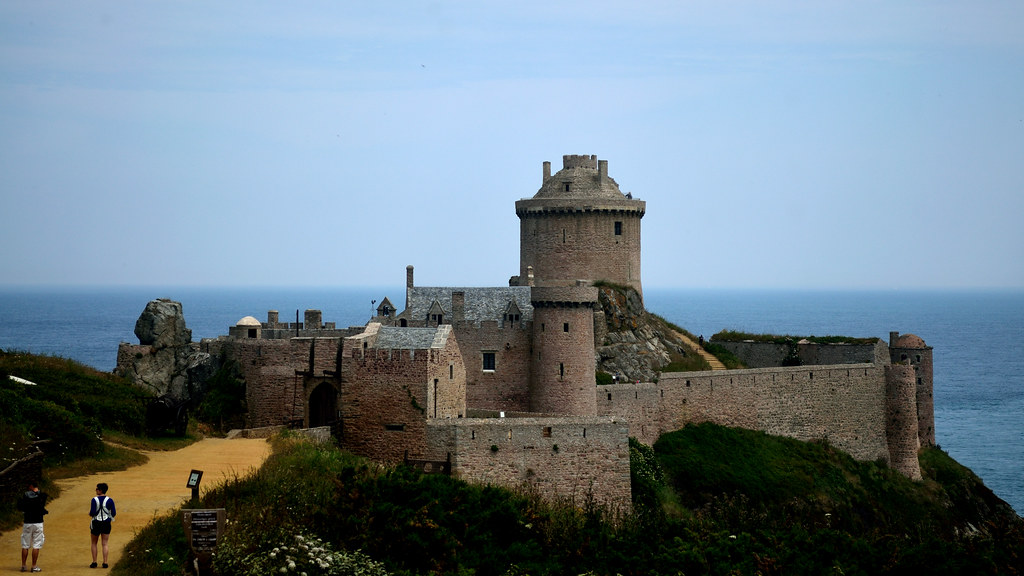
Cap Fréhel and Fort La Latte together deliver some of northern Brittany’s most spectacular coastal scenery – a combination of natural drama and architectural triumph that has captivated visitors for centuries. These two sites sit barely 4 kilometres apart on the windswept Emerald Coast, yet each offers something entirely different: Cap Fréhel is raw natural beauty (pink cliffs, wild moorland, seabird colonies), while Fort La Latte represents seven centuries of military architecture perched impossibly on rock above the crashing waves.
Pink Cliffs Among Europe’s Most Dramatic
Cap Fréhel is not hyperbole – it genuinely ranks among Europe’s most spectacular coastal headlands. The cape extends into the English Channel between the Bay of Saint-Brieuc and Saint-Malo harbour, with sheer cliffs of pink sandstone and shale rising over 70 metres above the sea. The geology here is exceptional: ancient rocks weathered into layers of red, pink, and grey that glow in the right light, creating a constantly changing palette as sun and clouds move across the sky.
From the clifftop, the views on clear days stretch from Jersey and the Cotentin Peninsula in the east to Paimpol and the Île de Bréhat in the west – a sweeping 180-degree panorama of the Côte d’Émeraude. Below, the sea crashes against the base of the cliffs in constant rhythm, and six small offshore islets provide nesting grounds for thousands of seabirds. This is big, wild coastal scenery – the kind that makes you understand why Brittany has inspired so many artists and writers.
Brittany’s Largest Coastal Moorland
The cape protects 400 hectares of coastal heathland – the largest in Brittany and one of the most ecologically important in France. This is not manicured parkland: it’s wild, windswept moorland that transforms dramatically through the seasons. In spring (April-June), the landscape explodes with bright yellow gorse and pink sea thrift – a combination so spectacular it stops first-time visitors in their tracks. In summer (July-August), purple heather carpets the headland, creating what looks like a lavender field by the sea.
The moorland is a protected nature reserve managed by the Conservatoire du littoral. Walking the paths through the heather, with the sea on one side and purple flowers stretching to the horizon on the other, is among Brittany’s great natural experiences. The combination of maritime climate, thin acidic soils, and constant Atlantic wind creates conditions where specialized plants and insects thrive – making this one of Europe’s rarest coastal ecosystems.
An Exceptional Seabird Reserve
Cap Fréhel is one of Brittany’s most important seabird sites. The cliffs and six offshore islets host nesting colonies of great cormorants, European herring gulls, kittiwakes, common guillemots, and – most notably – one of Brittany’s few razorbill colonies (only about 20 pairs, making every sighting significant). Between May and October, the air above the cliffs is constantly filled with wheeling birds, and the cacophony of calls echoes from the rock faces.
For birdwatchers, this is exceptional territory. The LPO (Ligue pour la Protection des Oiseaux) runs guided birdwatching sessions during peak nesting season. Even casual visitors will be struck by the sheer numbers and variety – binoculars are strongly recommended. The sight of razorbills diving for fish, cormorants returning to nests with beakfuls of seaweed, and gulls defending their territory is endlessly fascinating.
Fort La Latte: Seven Centuries of History
Fort La Latte (officially Château de la Roche Goyon) occupies one of the most dramatic castle sites in France. Built of local pink sandstone in the 14th century by Etienne Goyon, Lord of Matignon, the fortress perches on a narrow rocky cape extending into the sea. The approach involves crossing two successive drawbridges – the second offering that iconic photograph with Fort La Latte ahead and Cap Fréhel lighthouse in the distance.
Between 1690 and 1715, engineer Siméon Garangeau, working under Vauban (Louis XIV’s chief military engineer), transformed the medieval castle into a state-of-the-art coastal defence fort. They added artillery platforms, redesigned the fortifications for gunpowder warfare, and integrated the castle into the network of coastal defences protecting Saint-Malo from English and Dutch attack. The fort’s strategic position gave unobstructed views across the English Channel – perfect for early warning of approaching enemy fleets.
The castle has a turbulent history. In 1379 it was besieged and taken for the French crown by Bertrand Du Guesclin’s troops, before being returned to the Goyon family in 1381. An English siege in 1490 failed, but in 1597, during the Wars of the League, the castle was attacked, looted and burnt, leaving only the keep standing. Its spectacular setting and history earned it recognition as a Historic Monument in 1925. Since 1931, the Joüon des Longrais family have owned and painstakingly restored the castle, preserving its complete defensive system: drawbridges, keep, chapel, guard house, dungeons, medieval garden, and the Vauban-era cannon platforms. Today, Fort La Latte is Brittany’s most visited castle.
Hollywood Comes to Brittany: The Vikings (1958)
In 1958, Fort La Latte became an international film star. Director Richard Fleischer was shooting The Vikings, an epic adventure starring Kirk Douglas (who also produced), Tony Curtis, Janet Leigh, and Ernest Borgnine. The film was primarily shot in Norway’s spectacular fjords, but Fort La Latte was chosen to portray King Aella’s castle for the climactic battle scenes.
The castle’s dramatic position made it perfect for the film’s finale. Kirk Douglas and Tony Curtis performed their own stunts on the ramparts – including the famous sword fight – with the Atlantic crashing 70 metres below. Douglas also insisted on doing the dangerous “running the oars” stunt himself (leaping from oar to oar along a Viking longship). He nailed it in one take, and it’s caught on film.
The Vikings was a major box office success: $6.2 million in the US, $7 million overseas, and the third most popular film at the British box office in 1958. Kirk Douglas took 60% of profits instead of a salary and earned an estimated $3 million – a fortune in 1958. Today, you can stand exactly where Douglas and Curtis fought, walk the same ramparts, and understand immediately why Fleischer chose this location. The fort looks how a medieval castle should: impregnable, dramatic, and utterly commanding.