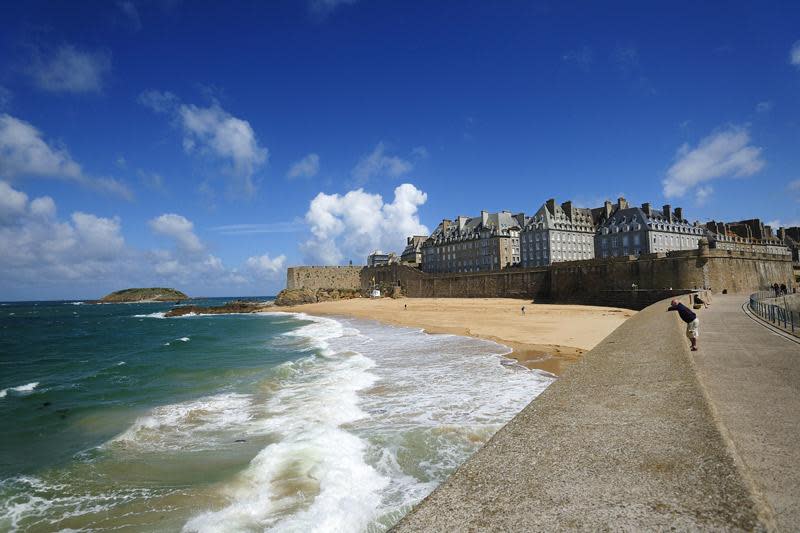
St Malo’s four main beaches sit within easy walking distance of the walled city. Each has its own character, shaped by the extraordinary tides that rise and fall up to 13 metres — among the highest in Europe.
1. Plage de Bon-Secours — The Iconic Tidal Pool Beach
Location: At the foot of the ramparts, accessed through Porte Saint-Pierre | Distance from ferry port: 1.2km (15-minute walk)
Bon-Secours is the most photographed beach in St Malo — and possibly all of Brittany. Built directly at the foot of the granite ramparts just west of the walled city, this beach has become the symbol of St Malo thanks to its remarkable seawater swimming pool that fills with every high tide and remains full when the sea retreats.
The pool was built in 1937 by René Lesaunier, owner of the “Bains René” bathing establishment. At the time, three beach offices competed for customers on Bon-Secours, and Lesaunier was frustrated that his regulars would travel to Dinard’s swimming pool during low tides when the sea retreated too far. His solution was revolutionary — create a natural seawater pool that would allow swimming 24 hours a day, regardless of tides. The pool features three diving boards that appear and disappear with the tides — offering a surreal sight when high tide submerges everything except the ghostly diving platform jutting from the water.
From Bon-Secours, you have stunning views across to Grand Bé (the tidal island where the writer Chateaubriand is buried) and Petit Bé with its 17th-century Vauban fort. At low tide, you can walk to both islands across the sand — the causeway to Grand Bé is accessible for roughly 2-3 hours either side of low tide. Fort National, another Vauban fortress from 1689, is also visible from here and accessible at low tide from nearby Plage de l’Éventail.
The beach itself is small but perfectly formed, with fine golden sand and excellent protection from the prevailing winds. It’s forbidden to dogs year-round, making it particularly pleasant for families. When you arrive by ferry from Portsmouth, this is the nearest beach to the port and makes an ideal first stop.
Best for: Families with children (safe swimming regardless of tide), photographers, Instagram shots, first-time visitors to St Malo, diving board enthusiasts
Water Temperature: 10-12°C in winter, 17-19°C in summer (July-August)
Facilities: Lifeguards (June-September), tidal pool with three diving boards, kayak and sailing dinghy rental, beach café/bar, showers, toilets, no dogs allowed
2. Plage du Sillon — France’s Most Beautiful Beach
Location: Stretches 3km from the ramparts northeast to Pointe de Rochebonne | Distance from ferry port: 1.5-4km depending on section
Voted France’s most beautiful beach by TripAdvisor users in 2018, 2021, and 2023, Plage du Sillon is St Malo’s largest and most celebrated beach — a magnificent 3-kilometre stretch of fine golden sand running northeast from the walled city. This north-facing beach is the crown jewel of St Malo’s coastline and offers something for everyone, from families seeking safe swimming to water sports enthusiasts chasing the constant winds of the Emerald Coast.
The beach takes its name from the old sand spit (le sillon) that once linked the Paramé district to the walled city and was the only dry access at low tide before the causeway was built. Originally just a strip of sand covered with dunes and windmills, the area was transformed between 1883 and 1913 when La Digue — the impressive sea wall promenade — was constructed. Today, this 1,671-metre promenade runs along the Grande Plage section, lined with magnificent Belle Époque villas built in the late 19th century when St Malo became a fashionable seaside resort.
The beach is actually divided into several named sections as you walk northeast from the old town: Plage de l’Éventail (closest to the ramparts, see below), Grande Plage du Sillon (the main central section and most popular), Plage de la Hoguette (at Paramé, near the thermal spa), and Plage de Rochebonne (at the far northeastern end, popular with surfers and beach sports). Each section has its own character but shares the same stunning golden sand and impressive tidal range.
The beach is protected by a line of impressive oak breakwaters (brise-lames) — hundreds of tree trunks driven deep into the sand at the beginning of the 19th century to protect the sea wall from the force of the waves. These iconic wooden posts have become a symbol of St Malo and create a distinctive visual feature along the shoreline. During high tide, the inner sections of the beach can disappear completely, with waves sometimes crashing dramatically over La Digue in storms — a spectacular sight from the safety of the promenade.
The constant winds make Plage du Sillon perfect for kitesurfing, windsurfing, and sand yachting — you’ll often see colorful kites dotting the sky. Several schools offer lessons for all ages, and the beach is particularly lively during summer when beach volleyball tournaments and sand sports take place. For those seeking a more relaxed experience, the 3-kilometre length means you can always find a quieter spot, and the promenade makes for an excellent sunset walk with views across to Dinard.
If you’re staying overnight after arriving on the Portsmouth St Malo ferry, Plage du Sillon is perfect for an early morning jog or evening stroll — many of the grand Belle Époque hotels overlook the beach, making it easy to access from your accommodation.
Best for: Long beach walks, water sports (kitesurfing, windsurfing, sand yachting), families needing space, sunset views, joggers, beach sports, Belle Époque architecture enthusiasts
Water Temperature: 10-12°C in winter, 17-20°C in summer (can exceed 20°C in August)
Facilities: Lifeguards at multiple stations (June-September), numerous beach clubs, restaurants and cafés along the entire promenade, showers, toilets, beach wheelchair access at several points, kitesurfing and windsurfing schools, sailing school at Hoguette, parking along La Digue, dogs allowed out of season (October-March)
3. Plage de l’Éventail — Gateway to Fort National
Location: Between the ramparts and Plage du Sillon, opposite Fort National
Plage de l’Éventail takes its name from its distinctive fan shape, which opens out dramatically at low tide. This family-friendly beach sits directly opposite Fort National — the granite fortress built by Vauban in 1689 that becomes accessible on foot at low tide. The beach marks the transition point between the small, sheltered beaches near the ramparts and the wide-open expanse of Plage du Sillon to the northeast.
Walking to Fort National from this beach is one of the classic St Malo experiences — the fort is accessible for roughly 3 hours either side of low tide, and guided tours run daily in summer. The beach itself is excellent for families, with gentle slopes and lifeguard supervision in season.
Best for: Families, walking to Fort National, less crowded than Bon-Secours
Facilities: Lifeguards (summer), easy access from the old town, showers, toilets
4. Plage du Môle — The Sheltered City Beach
Location: South of the ramparts, sheltered by the Môle des Noires jetty
Plage du Môle is the southernmost beach in St Malo — a small, sandy cove protected from the prevailing winds by the massive Môle des Noires breakwater that guards the harbour entrance. This makes it one of the most pleasant beaches in St Malo on a windy day, and particularly popular with locals who know where to find shelter when the northerly winds are blowing.
The beach has direct views across the estuary to Dinard, less than a kilometre away — you can see the Belle Époque villas clearly from here, and the regular ferry shuttles between St Malo and Dinard pass close by. The beach is small but rarely as crowded as Bon-Secours, making it a good alternative for those seeking a quieter spot close to the city.
Best for: Windy days, locals seeking peace, views across to Dinard
Facilities: Basic facilities, sheltered location, restaurant and bar nearby